BMS493 RAR agonist inhibition blocks retinoic acid signaling during T cell priming
Copy code to add this image to your page
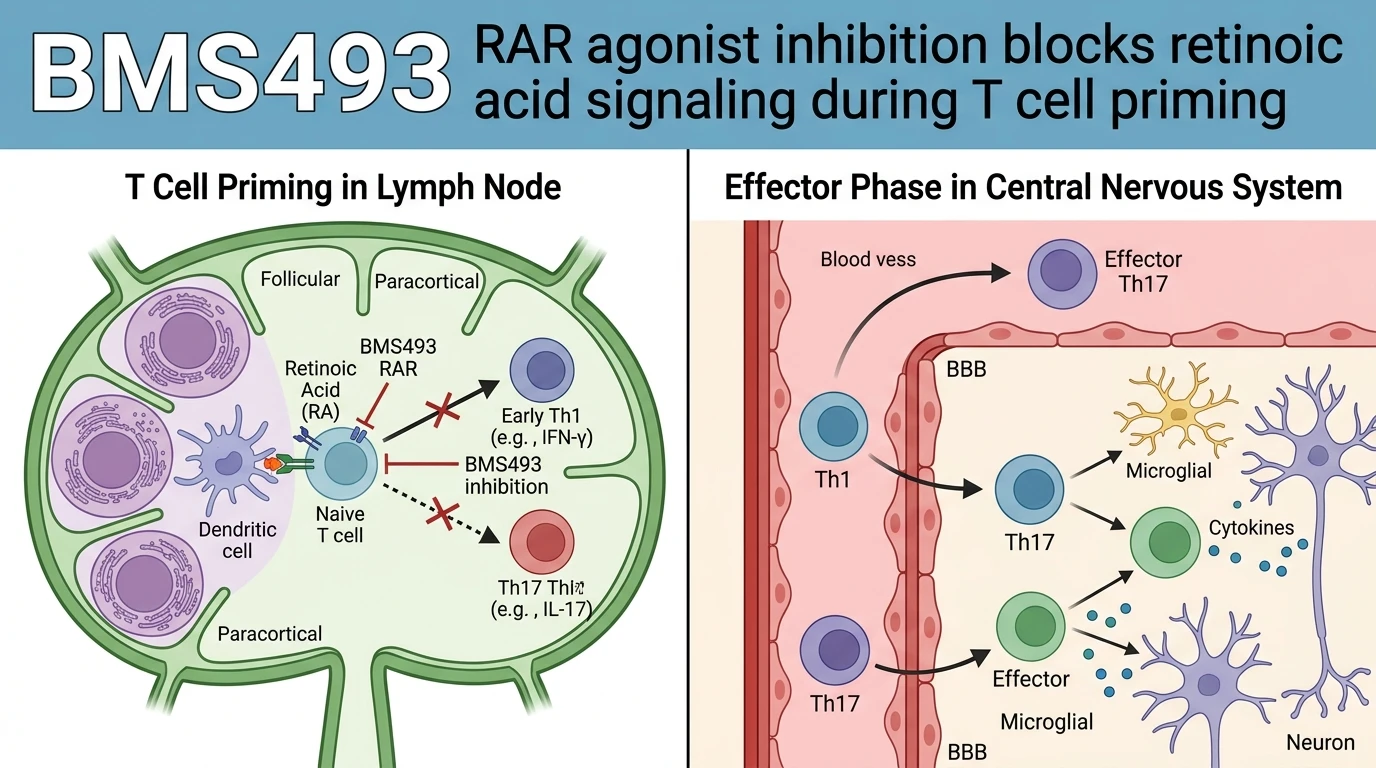
Retinoid metabolites derived from dietary Vitamin A (VitA) serve as critical upstream regulators of mammalian adaptive immune responses. Within the nuclear receptor superfamily, retinoic acid receptors (RARα, RARβ, and RARγ) function as ligand-dependent transcription factors that form heterodimers with retinoid X receptors (RXRs). Upon binding all-trans retinoic acid (RA), these heterodimers undergo conformational rearrangements that promote coactivator exchange and trigger specific transcriptional programs. In autoimmune neuroinflammation, including murine models of experimental autoimmune uveitis (EAU) and experimental autoimmune encephalomyelitis (EAE), canonical RA signaling regulates CD4+ T helper cell fate determination. Specifically, local concentrations of RA dictate the threshold for helper T cell type 1 (Th1) and type 17 (Th17) lineage specification during antigen-presenting cell interaction in secondary lymphoid organs.
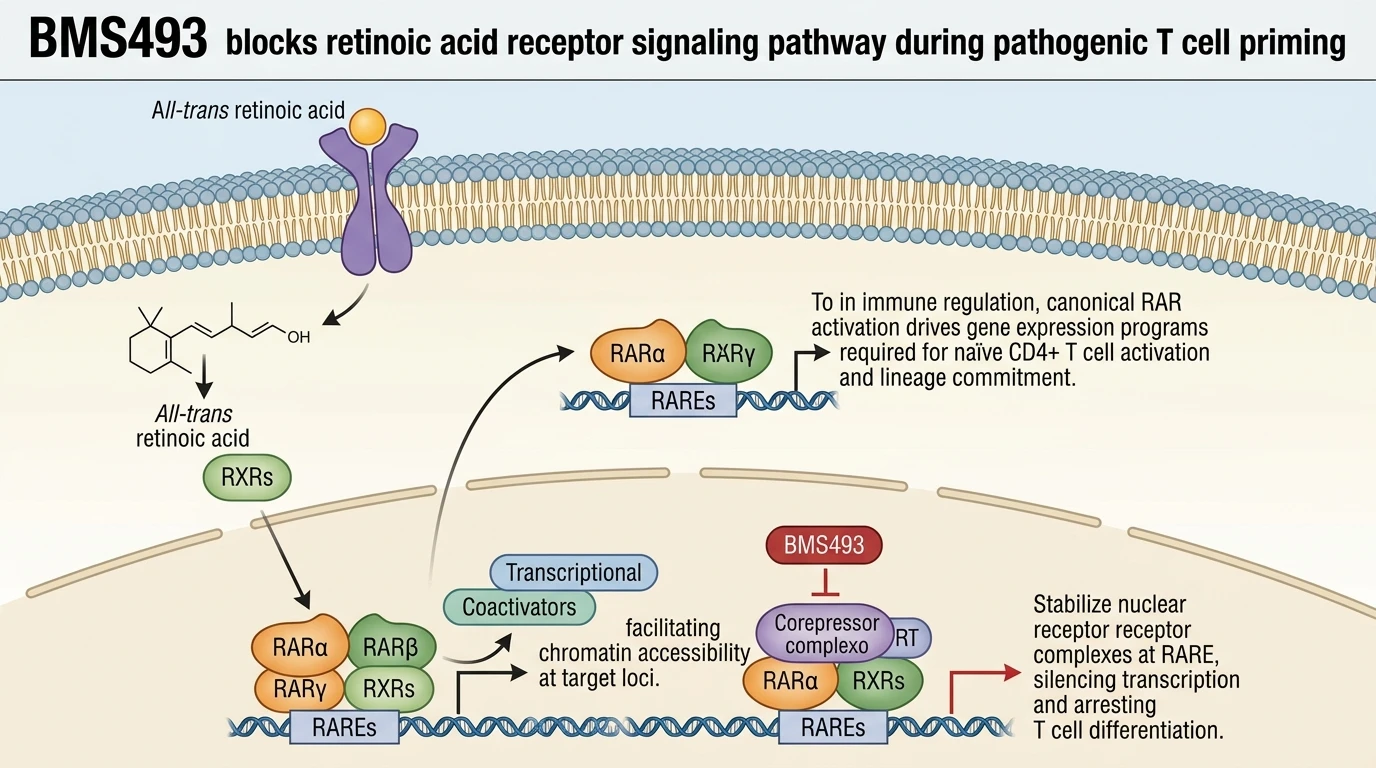
Experimental evaluation of retinoid dependence reveals a strict temporal requirement during autopathogenic T cell development. In models of complete dietary VitA deficiency, host animals exhibit robust resistance to EAU and EAE induction following autoantigen immunization. This protection correlates directly with impaired initial T cell priming, characterized by defective expression of lineage-defining transcription factors and diminished production of inflammatory cytokines such as IFN-γ and IL-17A. Pharmacological recapitulation of this deficient state is achievable using the synthetic pan-RA receptor inverse agonist BMS493. When administered during the initial priming phase, BMS493 actively stabilizes corepressor complexes—such as nuclear receptor corepressor 1 (NCoR1) and silencing mediator for retinoid and thyroid hormone receptors (SMRT)—at genomic retinoic acid response elements (RAREs). This intervention enforces active transcriptional repression, halting naïve T cell activation and preventing disease induction. Similar dynamic regulation of nuclear receptor signaling has been documented in broad cellular context analyses published in the Journal of Cell Biology.
Crucially, the requirement for RA signaling exhibits precise quantitative and temporal boundary conditions. Partial VitA deficiency, representative of physiological VitA insufficiency, fails to grant protection against neuroinflammation; instead, low residual retinoid levels remain fully permissive for EAU induction. Furthermore, timing dictates therapeutic efficacy. Pharmacological blockade using the BMS493 RAR agonist compound during the late effector phase—after autopathogenic T cells have completed initial priming in secondary lymphoid tissues—fails to suppress central nervous system (CNS) inflammation or attenuate clinical disease scores. Effector T cells generated under VitA-sufficient conditions retain their intrinsic pathogenicity upon adoptive transfer into VitA-deficient recipient mice. Paradoxically, these transferred effector populations induce exacerbated CNS tissue destruction in retinoid-deprived hosts, demonstrating that ongoing RA signaling is disposable for effector T cell migration, recall responses, and target tissue destruction. Thus, retinoid availability regulates an unalterable early commitment switch without dictating downstream effector cell viability.
Pharmacological Dissection of T Cell Priming and Effector Dynamics
Copy code to add this image to your page
BMS493 acts as a pan-retinoic acid receptor inverse agonist, binding RARα, RARβ, and RARγ to recruit corepressor complexes to nuclear RARE sites. This targeted intervention halts transcript activation necessary for naive CD4+ T cell differentiation into Th1 and Th17 lineages during antigen priming. Once T cells achieve effector status, their inflammatory capacity becomes independent of RA signaling.
Pan-RA Receptor Inhibition Silences Early T Cell Commitment
Targeting nuclear retinoic acid receptors during antigen presentation alters the transcriptional cascade required for T cell activation. Inverse agonism at these sites actively recruits corepressors. Administering the BMS493 RAR agonist tool compound during initial autoantigen exposure prevents the expression of RORγt and T-bet in naïve CD4+ T cells. Differentiation into Th17 and Th1 lineage phenotypes drops substantially under these conditions. Primary lymph node T cells fail to expand efficiently. Consequently, autoantigen-specific T cell pools remain below the threshold required to breach the blood-retinal or blood-brain barriers. Pharmacological intervention restricted to this early priming window confers durable resistance against EAU and EAE development.
Primed Effector T Cells Maintain Pathogenicity Independent of Retinoids
Temporal decoupling experiments demonstrate that mature effector T cells operate independently of ongoing retinoic acid signaling. Once CD4+ T cells complete initial lineage differentiation in VitA-replete lymph nodes, their inflammatory potential becomes fixed. Applying the BMS493 RAR agonist during the secondary effector phase does not reduce intraocular or spinal cord leukocyte infiltration. Cytokine production by established Th1 and Th17 cells remains unchanged in the presence of nuclear receptor inverse agonists. In adoptive transfer models, VitA-deficient hosts exhibit elevated neuroinflammation following effector cell challenge. Local tissue destruction proceeds uninhibited because target gene accessibility at effector loci no longer requires RAR coactivator recruitment. Retinoid dependence is strictly confined to the initial activation cascade.