Bomedemstat (IMG-7289) and LSD1 inhibition restore p53 signaling in myelofibrosis
Copy code to add this image to your page
Primary myelofibrosis and post-polycythemia vera or post-essential thrombocythemia myelofibrosis represent advanced phenotypic manifestations of chronic myeloproliferative neoplasms (MPNs). These clonal disorders originate within the hematopoietic stem cell compartment and are characterized by megakaryocytic hyperplasia, progressive bone marrow reticulin and collagen fibrosis, extramedullary hematopoiesis culminating in splenomegaly, and systemic symptoms mediated by circulating proinflammatory cytokines. At the molecular level, somatic driver mutations—most prominently JAK2V617F, CALR exon 9 indels, and MPL W515 mutations—induce constitutive activation of the JAK-STAT signaling axis. However, phenotypic progression and stem cell persistence depend heavily upon chromatin remodeling mechanisms governed by epigenetic modifiers.
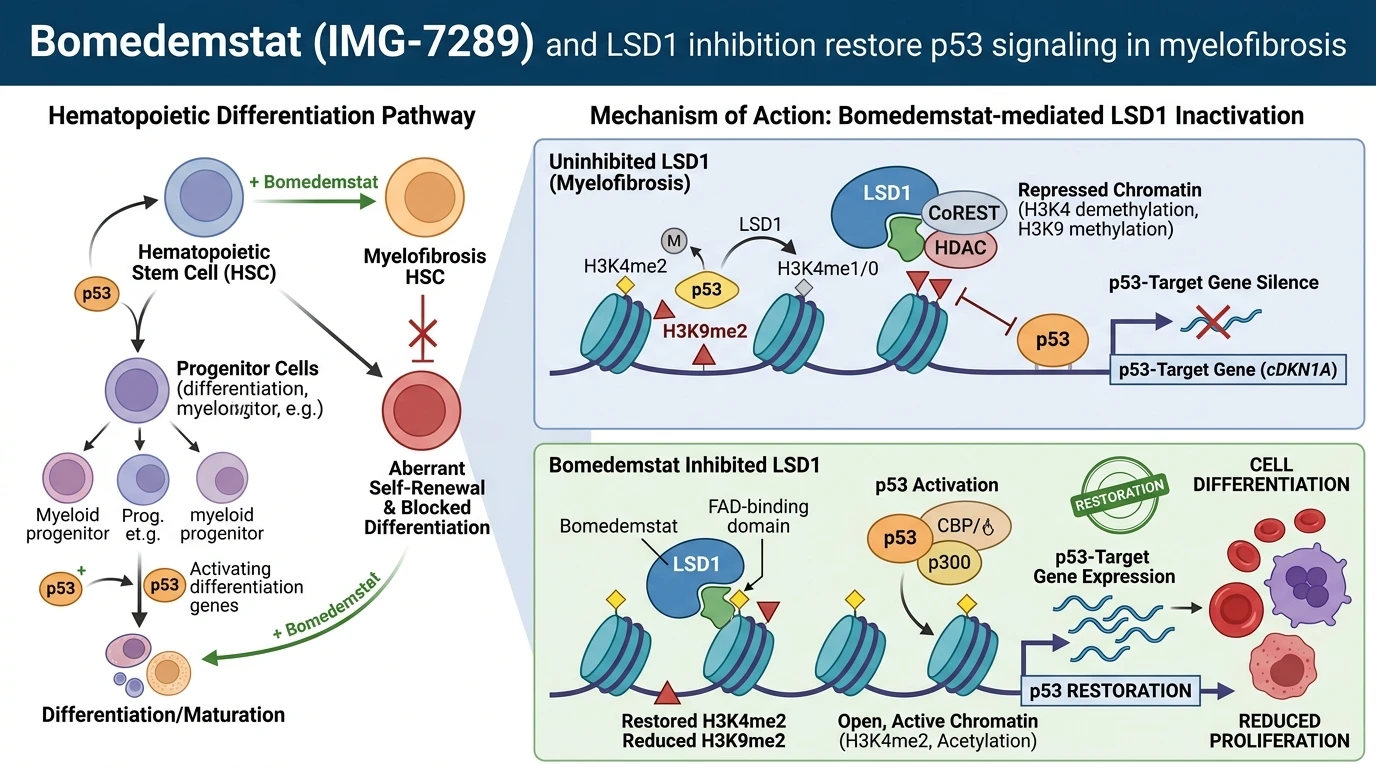
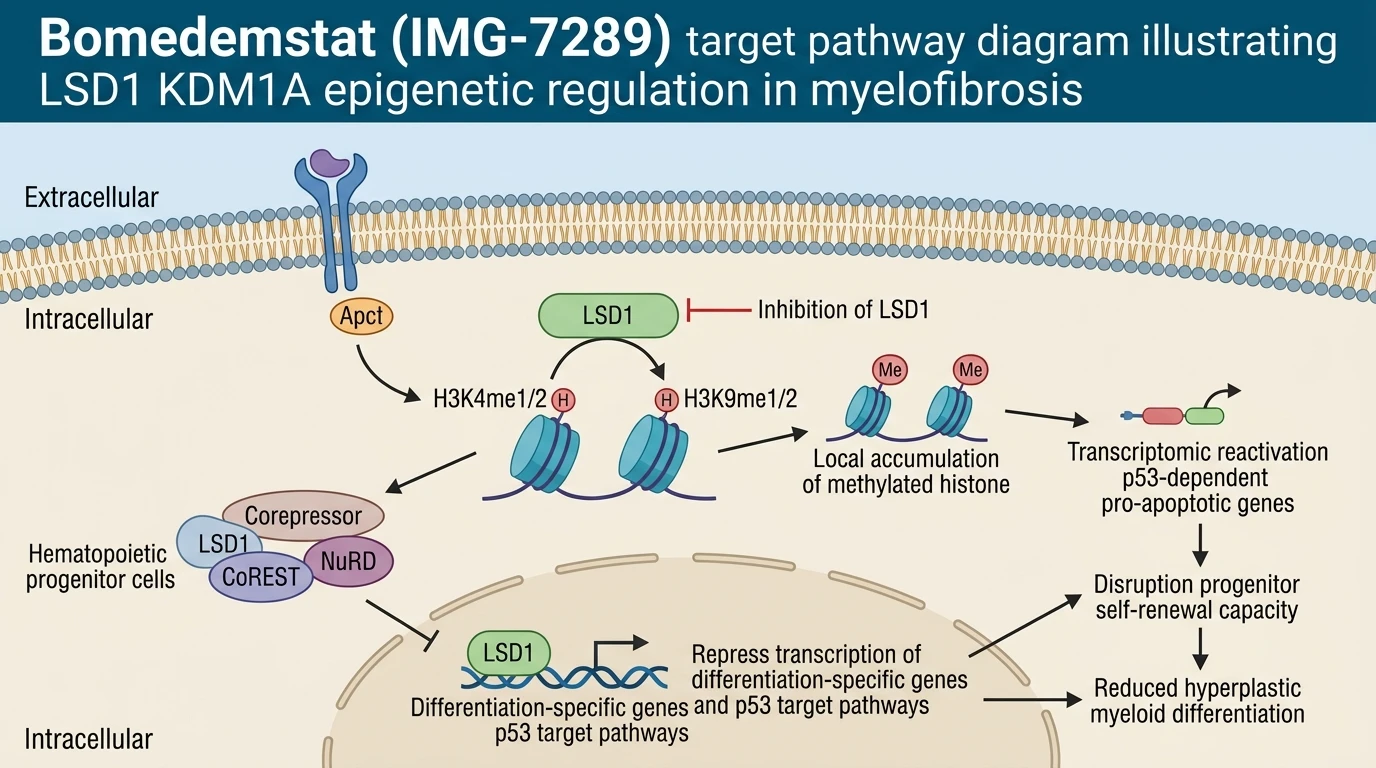
Lysine-specific demethylase 1 (LSD1/KDM1A) functions as a flavin adenine dinucleotide (FAD)-dependent amine oxidase that selectively removes mono- and di-methyl groups from lysine residues 4 and 9 of histone H3 (H3K4me1/2 and H3K9me1/2). Beyond its histone-modifying actions, LSD1 acts on non-histone substrates, including the tumor suppressor protein p53. Demethylation of p53 at Lys372 by LSD1 reduces p53 stability and suppresses its transactivation capacity. In neoplastic hematopoietic stem and progenitor cells (HSPCs), LSD1 is markedly overexpressed. Within these malignant populations, LSD1 associates with transcription factor complexes—such as GFI1, CoREST, and NuRD—to maintain stemness, block lineage differentiation, and evade p53-dependent apoptotic surveillance.
Bomedemstat (IMG-7289) is a potent, orally bioavailable, irreversible small-molecule inhibitor engineered to target LSD1/KDM1A. The compound features a cyclopropylamine core that undergoes an enzyme-catalyzed reaction within the amine oxidase domain of LSD1. This reaction forms a covalent adduct with the FAD cofactor, permanently disabling catalytic demethylase function. Covalent binding of IMG-7289 disrupts the interaction between LSD1 and its key transcriptional cofactor GFI1. Consequently, chromatin structure at differentiation-linked gene loci transitions to an open configuration characterized by increased H3K4 methylation. Simultaneously, inhibition of LSD1 prevents Lys372 demethylation on p53, leading to p53 stabilization, upregulation of p21 and PUMA target genes, and induction of selective apoptosis in pathogenic myeloid progenitor cells under evaluated assay conditions.
In preclinical animal models of myelofibrosis, including Jak2V617F transgenic and MPLW515L knock-in mice, daily administration of Bomedemstat (IMG-7289) delivered significant biological and pathological disease modification. Elevated peripheral blood leukocytes and thrombocytes normalized rapidly following treatment initiation. Pathogenic megakaryocytes, which secrete fibrogenic cytokines like TGF-beta-1 and PDGF, displayed high susceptibility to LSD1 inhibition. Reduced megakaryocyte numbers correlated directly with decreases in splenomegaly and marked attenuation of bone marrow reticulin fibrosis. Importantly, serial transplantation assays revealed that LSD1 blockade impaired the self-renewal and competitive repopulating ability of mutant HSPCs, resulting in sustained reductions in variant allele frequency.
Translational evidence from ongoing Phase 2 clinical trials evaluating Bomedemstat (IMG-7289) in patients with advanced myelofibrosis, including those previously treated with or resistant to JAK inhibitors, confirms meaningful therapeutic efficacy. Orally administered once daily, the drug reduced total symptom score metrics and produced spleen volume reductions without triggering severe dose-limiting myelosuppression. Longitudinal molecular tracking demonstrated reductions in mutant allele burdens, including JAK2V617F, CALR, and high-risk ASXL1 variants. In baseline-anemic patient cohorts, treatment stabilized or improved hemoglobin concentrations and reduced red blood cell transfusion burdens. Biopsy evaluations supported these clinical improvements, showing stabilization or regression of bone marrow fibrosis grades in a measurable proportion of subjects.
These integrated cellular and clinical data demonstrate that direct enzymatic inhibition of LSD1 alters the epigenetic regulatory network governing MPN stem cell dynamics. By targeting both chromatin structure and p53 stability, Bomedemstat (IMG-7289) addresses driver-mutation independent pathways required for clonal survival, providing a compelling pharmacological approach for myelofibrosis management.
Pharmacological Evaluation and Epigenetic Targeted Efficacy
Copy code to add this image to your page
Bomedemstat (IMG-7289) irreversibly inhibits lysine-specific demethylase 1 (LSD1/KDM1A) by forming a covalent adduct with its FAD cofactor. In myeloproliferative neoplasms, this catalytic inactivation elevates H3K4me1/2 levels, restores p53-mediated gene transcription, and disrupts LSD1-GFI1 cofactor interaction. The resulting chromatin remodeling induces apoptosis in pathogenic myeloid progenitors, suppresses pro-fibrotic megakaryocyte cytokine secretion, reduces mutant allele burdens, and attenuates bone marrow fibrosis.
Inhibition of LSD1 Restores p53 Activity and Differentiation
Epigenetic targeting of LSD1 re-establishes transcriptional control over dysregulated hematopoietic differentiation. In cultured human MPN cell lines, catalytic blockade by IMG-7289 increased genomic H3K4me2 levels within hours. Downstream p53 target expression rose promptly. Cell cycle arrest occurred at the G1/S transition without immediate necrotic lysis. This response relies upon intact p53 activation pathways. In primary patient-derived megakaryocytic progenitors, drug exposure suppressed pro-fibrotic cytokine release under tested in vitro conditions. Consequently, aberrant cell proliferation diminished while normal erythrocyte differentiation remained largely preserved.
Reduction of Mutant Allele Burden in Xenograft Models
In vivo studies in Jak2V617F mouse models confirmed marked disease modification following systemic drug delivery. Splenomegaly regressed within two weeks of daily oral dosing. Reticulin staining revealed clear reduction of marrow fibrosis. Analysis of hematopoietic stem cell fractions demonstrated reduced clonogenic self-renewal capacity. Furthermore, treatment with IMG-7289 depleted mutant stem cell pools while sparing non-mutant progenitors in competitive transplantation models. Mutant allele burden decreased systematically across serial blood sampling timepoints. These observations suggest that persistent LSD1 inhibition preferentially eliminates disease-propagating clones in vivo.