Catadegbrutinib (BGB-16673) Targeted BTK Degradation Overcomes Resistance in B-Cell Malignancies
Copy code to add this image to your page
Targeting Bruton's tyrosine kinase (BTK) redefined clinical management in chronic lymphocytic leukemia (CLL) and non-Hodgkin lymphoma. First-generation covalent inhibitors, such as ibrutinib, engage the conserved C481 residue within the ATP-binding pocket. While initial clinical response rates proved high, acquired resistance remains a major clinical challenge. The predominant mechanism of relapse involves a cysteine-to-serine substitution (C481S), which prevents covalent adduct formation and diminishes drug occupancy. Non-covalent, reversible BTK inhibitors like pirtobrutinib were developed to circumvent C481 reliance. However, secondary gatekeeper mutations and kinase-dead variants (such as T474I and L528W) frequently emerge during extended non-covalent therapy, rendering standard small-molecule inhibition ineffective.
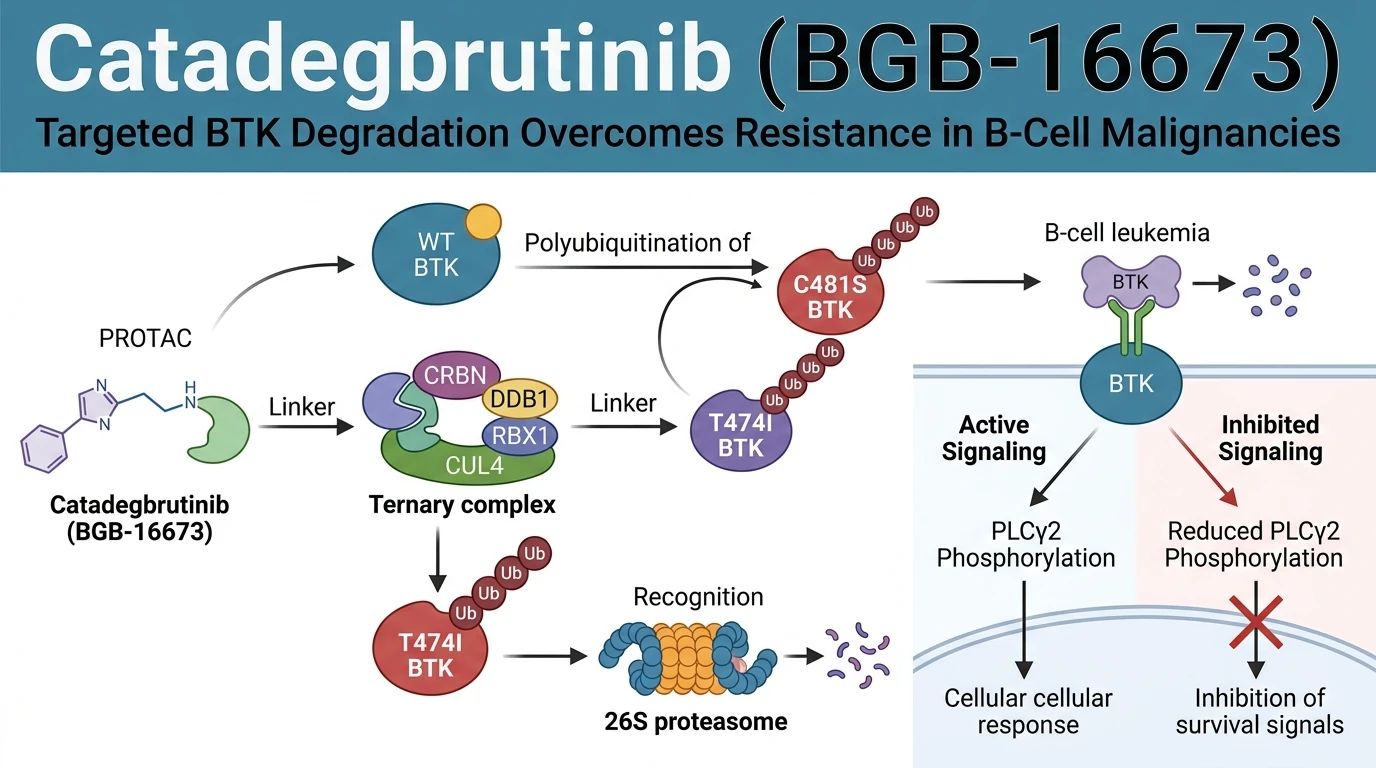
To address these treatment bottlenecks, targeted protein degradation via Proteolysis Targeting Chimeras (PROTACs) offers a distinct pharmacological approach. Instead of merely blocking catalytic occupancy, PROTACs eliminate the target protein entirely. Catadegbrutinib (BGB-16673) is a heterobifunctional molecule engineered to induce selective degradation of BTK. The molecular construct of BGB-16673 features a high-affinity BTK-binding ligand tethered via a flexible linker to an E3 ubiquitin ligase recognition motif. Binding triggers proximity-induced ternary complex formation between BTK and the E3 ligase complex. This spatial orientation allows the E3 ligase to transfer ubiquitin molecules onto accessible lysine residues on the BTK surface. Polyubiquitinated BTK is subsequently recognized and degraded by the 26S proteasome.
Because event-driven degradation does not require continuous active-site occupancy, Catadegbrutinib operates sub-stoichiometrically. After initiating ubiquitin transfer on one BTK monomer, the degrader molecule dissociates to engage additional targets. In vitro biochemical assays demonstrate that Catadegbrutinib retains potent degrading activity against both wild-type BTK and common drug-resistant mutant isoforms, including C481S and T474I. Target clearance terminates scaffold-dependent interactions alongside enzymatic activity. Consequently, downstream signaling node activation—specifically phospholipase C-gamma 2 (PLCg2) phosphorylation—is suppressed at sub-nanomolar concentrations.
Early-phase clinical evaluations in relapsed or refractory B-cell malignancies confirm significant target reduction in patient-derived peripheral blood mononuclear cells. Depletion of BTK correlates with reduced disease burden in heavily pretreated patient cohorts previously exposed to both covalent and non-covalent BTK inhibitors. However, prolonged therapeutic pressure selects for novel escape mechanisms. Emergent mutations, such as the kinase-impaired BTK-A428D variant, have been documented in patients developing progressive disease during clinical evaluation. Structural characterization suggests that A428D induces conformational shifts that impair ternary complex assembly or destabilize overall protein folding, establishing a critical boundary condition for PROTAC efficacy.
Pharmacological Characterization and Resistance Dynamics
Copy code to add this image to your page
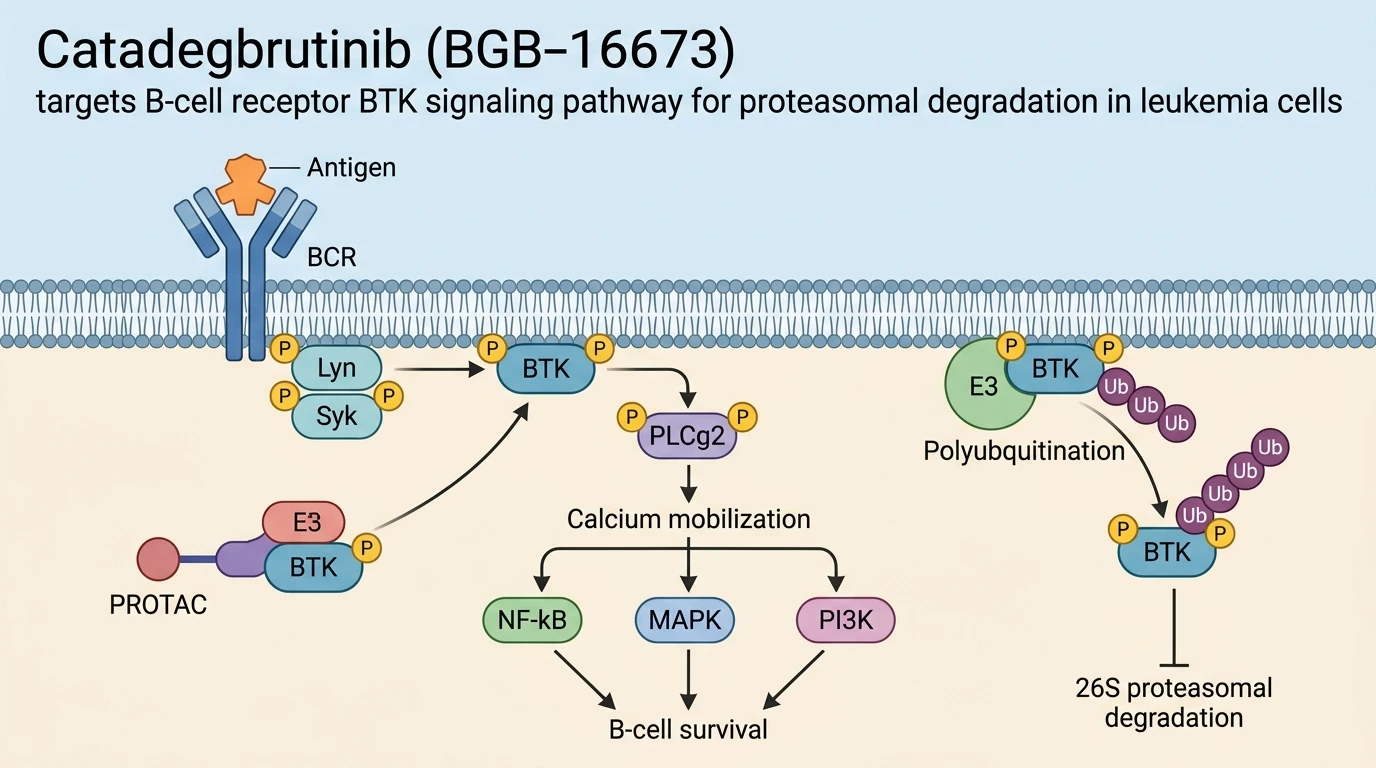
Catadegbrutinib (BGB-16673) operates as a heterobifunctional PROTAC degrader targeting Bruton's tyrosine kinase (BTK). By simultaneously binding BTK and an E3 ubiquitin ligase, Catadegbrutinib induces ternary complex formation, polyubiquitination, and subsequent 26S proteasomal degradation of BTK. This mechanism removes both wild-type and mutant BTK variants (including C481S and T474I), terminating downstream PLCg2 phosphorylation and NF-kB signaling in B-cell malignancies.
Proteasomal Degradation Depletes Mutated BTK Isoforms
Analytical evaluation in engineered lymphoma cell models confirms rapid catalytic target depletion. Catadegbrutinib induces sub-nanomolar degradation of wild-type BTK within two hours of application. Kinetics remained comparable across C481S and T474I mutant lines in vitro. Downstream phospho-PLCg2 levels dropped precipitously following drug treatment. Short-term exposure suppressed nuclear factor kappa B (NF-kB) transcriptional programs. The catalytic nature of degrader molecules allows sustained signaling suppression post-washout. Proteasomal inhibitors fully blocked target depletion, confirming ubiquitin-dependent processing.
Kinase-Impaired A428D Variant Alters Degradation Susceptibility
Genomic analysis of progression samples identified secondary kinase domain alterations. The A428D substitution severely impairs intrinsic BTK catalytic activity while altering protein stability. Biophysical modeling indicates disrupted contact surfaces required for stable ternary complex formation with Catadegbrutinib. Cellular assays showed prolonged degradation half-lives for the A428D mutant protein. Target turnover was markedly delayed compared to wild-type controls. These experimental facts confirm that structural perturbations in BTK can compromise degradation efficiency independently of ATP-binding affinity.