WRN Inhibitors
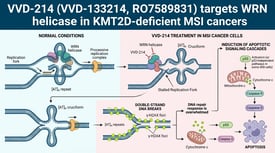
The Werner syndrome helicase (WRN) is a member of the RecQ family of DNA helicases, which also includes BLM and RECQL4. WRN is unique among human RecQ helicases because it possesses both 3'-to-5' helicase activity and 3'-to-5' exonuclease activity. It plays a critical role in maintaining genomic stability by participating in various DNA repair pathways, including homologous recombination, non-homologous end joining, and the restart of stalled replication forks. The importance of WRN is highlighted by Werner syndrome, a rare autosomal recessive disorder caused by loss-of-function mutations in the WRN gene, characterized by premature aging and a high predisposition to cancer. In recent years, WRN has emerged as a high-priority target in oncology due to the discovery of a profound synthetic lethal relationship. Specifically, cancer cells with high microsatellite instability (MSI-H)—often resulting from defects in the mismatch repair (MMR) system—are exquisitely dependent on WRN for survival. In MSI-H cells, repetitive DNA sequences are prone to forming non-canonical DNA structures like G-quadruplexes and large insertions/deletions.
WRN is required to resolve these structures during replication; its absence leads to massive double-strand breaks, chromosomal fragmentation, and rapid cell death. This makes WRN inhibitors a promising strategy for treating MSI-H colorectal, gastric, and endometrial cancers. The research status of WRN inhibitors has rapidly advanced from target validation to clinical development. Several pharmaceutical companies have recently unveiled potent and selective small-molecule inhibitors. For example, HRO761 is an allosteric WRN inhibitor that has entered Phase I clinical trials. These molecules typically target the ATPase domain of the helicase, preventing the energy-dependent unwinding of DNA. Preclinical studies have demonstrated that these inhibitors selectively kill MSI-H cells while sparing microsatellite stable (MSS) cells, providing a wide therapeutic index.
WRN inhibitors can be classified into two main types: ATPase inhibitors and exonuclease inhibitors. Most current drug discovery efforts are focused on the helicase/ATPase domain, as this activity is essential for resolving the DNA structures that cause toxicity in MSI-H cells. Some research compounds are orthosteric inhibitors that compete with ATP, while newer generations are allosteric, offering better selectivity over other RecQ family members like BLM, which is crucial to avoid general genomic instability in healthy cells. One of the primary challenges in developing WRN inhibitors is the high structural similarity between the five human RecQ helicases. Off-target inhibition of BLM, for instance, could lead to Bloom syndrome-like phenotypes, including increased sister chromatid exchange and cancer risk. Additionally, as with many targeted therapies, there is a potential for the development of resistance, perhaps through the upregulation of alternative helicases or bypass repair pathways. Future research is focused on identifying biomarkers of response beyond MSI-H status and exploring combinations with other DNA damage response (DDR) inhibitors or immune checkpoint inhibitors to enhance the durability of the clinical response.