VVD-214 (VVD-133214, RO7589831) targets WRN helicase in KMT2D-deficient MSI cancers
Copy code to add this image to your page
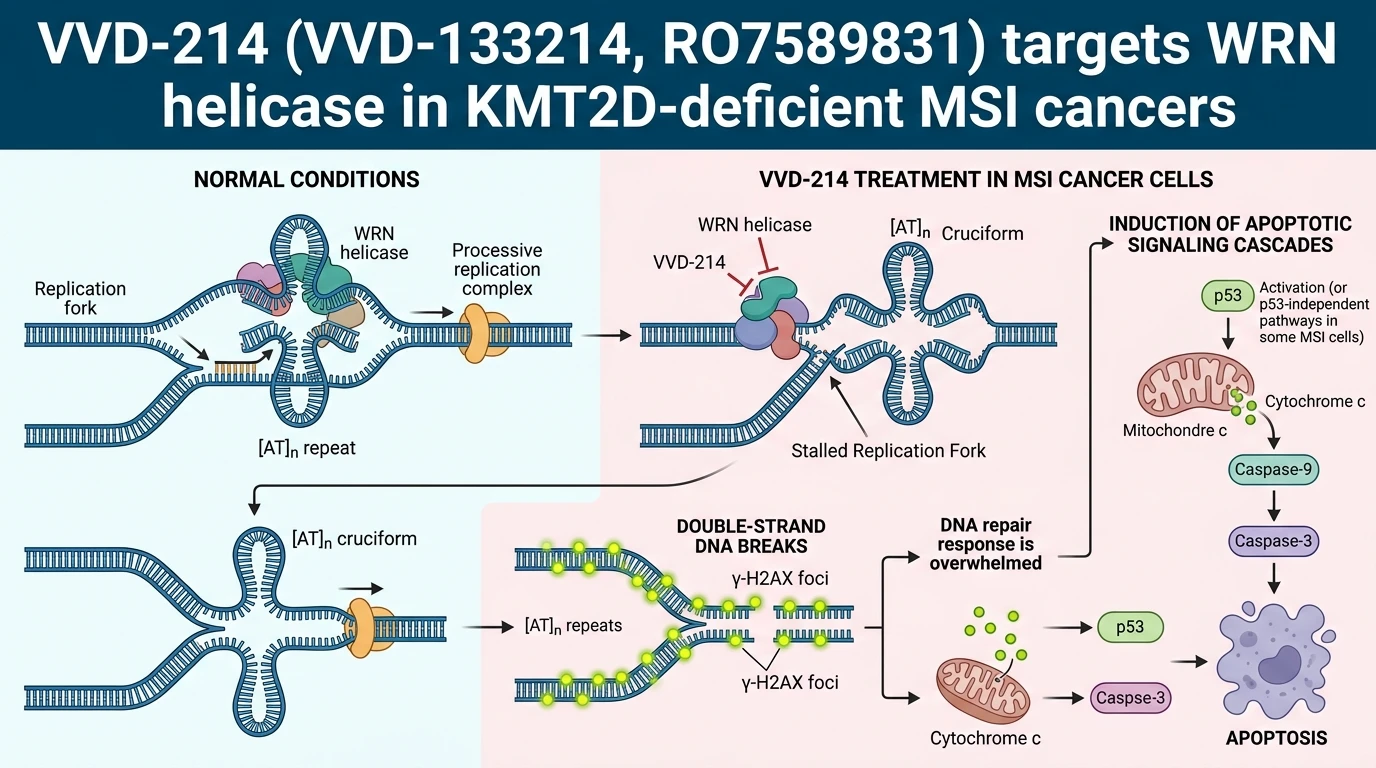
Microsatellite instability (MSI) resulting from defective DNA mismatch repair creates distinct vulnerability profiles in human malignancies. Among these dependencies, Werner syndrome ATP-dependent helicase (WRN) represents an essential enzyme required for maintaining genomic stability during replication of expanded non-canonical DNA structures. Recent functional genomic screens identify KMT2D loss-of-function (LOF) mutations as a critical predictive biomarker governing cell sensitivity to small-molecule WRN inhibitors. The small-molecule compound VVD-214 (VVD-133214, RO7589831) selectively binds the WRN helicase domain, trapping the enzyme in an inactive state and precipitating double-strand breaks at unstable genomic loci. While WRN dependence is broadly recognized across mismatch repair-deficient models, baseline responsiveness varies across distinct cellular lineages. Genetic inactivation of the histone methyltransferase KMT2D significantly amplifies this phenotype. Specifically, KMT2D deficiency elevates baseline [AT]n dinucleotide repeat expansions within the genome. These expanded tracks readily form secondary cruciform structures during transcription and DNA replication. Consequently, the reliance on WRN to resolve stalled replication forks at these loci increases substantially.
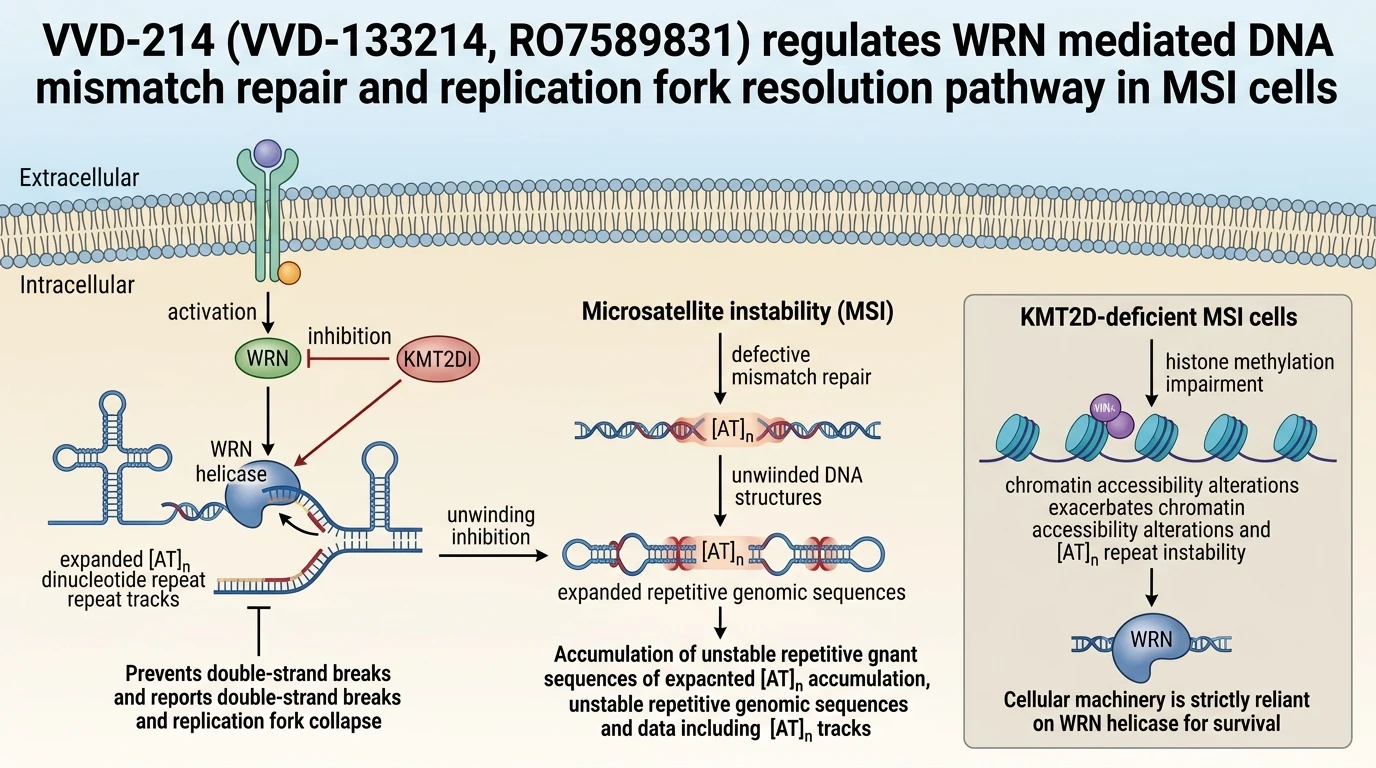
At the molecular level, KMT2D regulates epigenetic accessibility by catalyzing monomethylation of histone H3 at lysine 4 (H3K4me1) at enhancer regions. Loss of KMT2D perturbs local chromatin architecture, leading to increased transcriptional stress and secondary DNA structure formation at repetitive sequences. In MSI cell lines harboring wild-type KMT2D, [AT]n repeat lengths often remain below the threshold required for severe replication collapse upon partial WRN inhibition. Conversely, co-occurrence of MSI and KMT2D LOF mutations creates a compounding state of severe genomic stress. Pharmacological engagement of WRN by VVD-214 suppresses helicase activity, preventing the unwinding of sterically hindered [AT]n cruciforms. Unresolved cruciforms induce replication fork stalling, activate ATM/ATR kinase signaling, and culminate in lethal double-strand DNA breaks. In vitro profiling confirms that KMT2D-deficient MSI lines demonstrate nanomolar IC50 values upon treatment with VVD-214, whereas KMT2D wild-type counterparts exhibit minimal growth inhibition under identical assay conditions.
Biophysical studies indicate that VVD-214 binds allosterically to the helicase domain of WRN, preventing ATP hydrolysis necessary for strand separation. Xenograft studies in immunocompromised mice bearing KMT2D-deficient MSI colorectal and gastric carcinomas demonstrate significant tumor regression following oral administration of VVD-214. Pharmacodynamic biomarkers, including phosphorylation of histone H2AX (γH2AX) and Kap1, confirm target engagement and sustained double-strand break accumulation within tumor tissue. Importantly, non-cancerous tissue lacking mismatch repair defects displays no detectable toxicity at therapeutic doses, reinforcing the synthetic lethal selectivity margin. The identified interaction between KMT2D deficiency and WRN inhibition provides a refined patient stratification strategy for clinical evaluation.
Biomarker Stratification and Pharmacodynamic Evaluation of WRN Inhibition
Copy code to add this image to your page
VVD-214 (VVD-133214, RO7589831) is an allosteric inhibitor of WRN helicase that induces synthetic lethality in microsatellite instability (MSI) cancer cells. KMT2D loss-of-function mutations amplify [AT]n dinucleotide repeat expansions, creating non-canonical secondary DNA structures that stall replication forks. WRN helicase inhibition by VVD-214 prevents the unwinding of these secondary DNA structures, resulting in persistent replication fork collapse, double-strand DNA break accumulation, ATM/ATR pathway activation, and selective apoptosis in KMT2D-deficient MSI tumor cells.
KMT2D Deficiency Accelerates [AT]n Repeat Expansion Instability
Epigenetic dysregulation directly alters genomic instability patterns in mismatch repair-deficient cancers. Loss of KMT2D methyltransferase activity impairs H3K4me1 deposition at enhancer loci, inducing aberrant transcription-associated replication stress and localized chromatin remodeling. [AT]n repeat tracks expand rapidly. These expanded dinucleotide repeats fold into stable secondary cruciform structures during S-phase DNA synthesis, physically stalling DNA polymerase progression along the template strand. Replication forks collapse without intervention. Under these specific genomic conditions, VVD-214 inhibits the essential unwinding activity of WRN, rendering the cell incapable of clearing physical DNA blockages. Genomic fragmentation follows within hours.
Targeted WRN Inhibition Induces Selective Lethality In Vivo
In vivo xenograft models validate this biomarker-driven synthetic lethal dependency. Mice bearing KMT2D-deficient MSI tumor xenografts exhibited marked volume reduction following daily oral treatment with VVD-214 at pharmacologically effective doses. Intratumoral γH2AX signal elevated significantly. This biomarker increase coincided with cleavage of poly(ADP-ribose) polymerase (PARP) and caspase-3, confirming the activation of programmed apoptotic cascades following unmitigated double-strand break accumulation. Systemic tolerability remained uncompromised throughout treatment. These animal observations confirm that KMT2D status effectively predicts cell-autonomous sensitivity to allosteric WRN helicase blockade.