KRas Inhibitors
Kirsten rat sarcoma viral oncogene homolog (KRas) is a small GTPase that acts as a molecular switch in signal transduction pathways, primarily downstream of receptor tyrosine kinases. KRas cycles between an inactive GDP-bound state and an active GTP-bound state. Upon activation by guanine nucleotide exchange factors (GEFs), KRAS binds GTP and recruits effector proteins, such as RAF kinases (initiating the MAPK/ERK pathway) and PI3K (initiating the PI3K/AKT pathway). These pathways regulate fundamental cellular processes including proliferation, differentiation, survival, and migration. KRAS is one of the most frequently mutated oncogenes in human cancers. Mutations in KRAS, particularly at codons 12, 13, and 61, lead to a constitutively active GTP-bound state, as the mutated protein is resistant to GTP hydrolysis mediated by GTPase-activating proteins (GAPs). This sustained activation of downstream signaling pathways drives uncontrolled cell growth, survival, and metastasis, making mutant KRAS a critical driver in many aggressive cancers, including non-small cell lung cancer (NSCLC), pancreatic cancer, and colorectal cancer. The prevalence and aggressive nature of KRAS-mutant cancers have made KRAS a highly sought-after, yet historically intractable, therapeutic target.
Current research on KRAS inhibitors has seen a significant breakthrough in recent years. For decades, KRAS was considered 'undruggable' due to its smooth surface and lack of deep binding pockets. However, the development of covalent inhibitors that target specific KRAS mutations has revolutionized the field. The first generation of these inhibitors, such as sotorasib and adagrasib, specifically target the KRAS G12C mutation, which occurs in about 13% of KRAS-mutant lung cancers. These inhibitors bind covalently to the cysteine residue at position 12 in the mutated protein, locking it in an inactive state and preventing downstream signaling. Sotorasib has received FDA approval for KRAS G12C-mutated NSCLC, marking a major milestone. Research is ongoing to develop inhibitors for other KRAS mutations (e.g., G12D, G12V) and to overcome resistance mechanisms. KRAS inhibitors are primarily classified by the specific mutation they target.
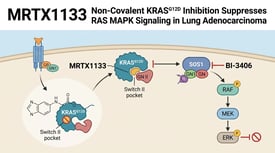
The most advanced class targets the KRAS G12C mutation. These are typically covalent inhibitors that exploit the presence of the cysteine residue. Non-covalent inhibitors targeting other KRAS mutations are also under development. Inhibitors can also be classified by their mechanism of action: direct inhibitors that bind to KRAS itself, or indirect inhibitors that target upstream activators or downstream effectors. Research tool compounds like the non-hydrolyzable GTP analog GDP-beta-S have been used to study KRAS function. Key challenges in KRAS inhibitor development include the heterogeneity of KRAS mutations, the emergence of resistance mechanisms (e.g., bypass signaling pathways, secondary KRAS mutations), and potential toxicities. Achieving broad efficacy across different KRAS mutation types remains a major goal. Combination therapy strategies are crucial, with ongoing trials exploring combinations of KRAS G12C inhibitors with chemotherapy, immunotherapy, or other targeted agents to enhance efficacy and overcome resistance.
Developing inhibitors for the more common non-G12C KRAS mutations is a high priority. Understanding the complex interplay of KRAS with other signaling pathways is essential for designing next-generation inhibitors and effective combination treatments.