Ras Inhibitors
The Ras family of small GTPases, including KRAS, HRAS, and NRAS, are among the most frequently mutated oncogenes in human cancer. Ras proteins function as molecular switches that cycle between an inactive GDP-bound state and an active GTP-bound state. This cycling is regulated by Guanine Nucleotide Exchange Factors (GEFs) and GTPase-Activating Proteins (GAPs). When mutated, Ras remains constitutively in the active GTP-bound state, leading to persistent signaling through downstream pathways such as the MAPK/ERK and PI3K/AKT pathways. These pathways drive fundamental cellular processes including proliferation, survival, and differentiation. Mutations in Ras, particularly KRAS, are predominant in pancreatic ductal adenocarcinoma, colorectal cancer, and non-small cell lung cancer (NSCLC).
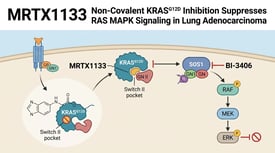
For decades, Ras was considered "undruggable" due to its high affinity for GTP and the lack of suitable deep binding pockets on its relatively smooth surface. However, a breakthrough occurred with the discovery of a covalent binding pocket in the KRAS G12C mutant. This led to the development and FDA approval of sotorasib (AMG 510) and adagrasib (MRTX849), which specifically target the cysteine residue in the G12C mutant, locking the protein in its inactive GDP-bound state. These approvals marked a historic milestone in oncology. Current research has now expanded to target other common mutations, such as G12D and G12V, and to develop "pan-RAS" inhibitors that can target multiple Ras isoforms or mutants simultaneously. Ras inhibitors can be classified into several categories: mutant-specific covalent inhibitors (like G12C inhibitors), non-covalent inhibitors, GEF-Ras interaction inhibitors (e.g., SOS1 inhibitors), and PROTAC-based degraders.
Additionally, there are indirect strategies such as targeting the post-translational modifications required for Ras membrane localization (e.g., farnesyltransferase inhibitors) or inhibiting downstream effectors like MEK or ERK. Despite the success of G12C inhibitors, clinical resistance often emerges through various mechanisms, including secondary mutations in KRAS, bypass signaling activation, or epithelial-to-mesenchymal transition (EMT). To address resistance, combination therapy strategies are being extensively investigated. Combining Ras inhibitors with SHP2 inhibitors, SOS1 inhibitors, or EGFR inhibitors has shown promise in preclinical and early clinical studies by more completely suppressing the MAPK pathway. Furthermore, the integration of Ras inhibitors with immunotherapy is a major area of focus, as Ras signaling is known to modulate the tumor immune microenvironment. Challenges remain in developing potent inhibitors for the G12D mutation, which is the most common KRAS mutation across all cancers, and in managing the toxicities associated with pan-RAS inhibition.
Nevertheless, the rapid progress in Ras-targeted therapies has transformed the treatment landscape for patients with Ras-mutant cancers, shifting the focus from whether Ras can be drugged to how to optimize its inhibition and overcome resistance.