Apatinib (YN968D1) mesylate VEGFR inhibitor evaluation in advanced extramammary Paget's disease
Copy code to add this image to your page
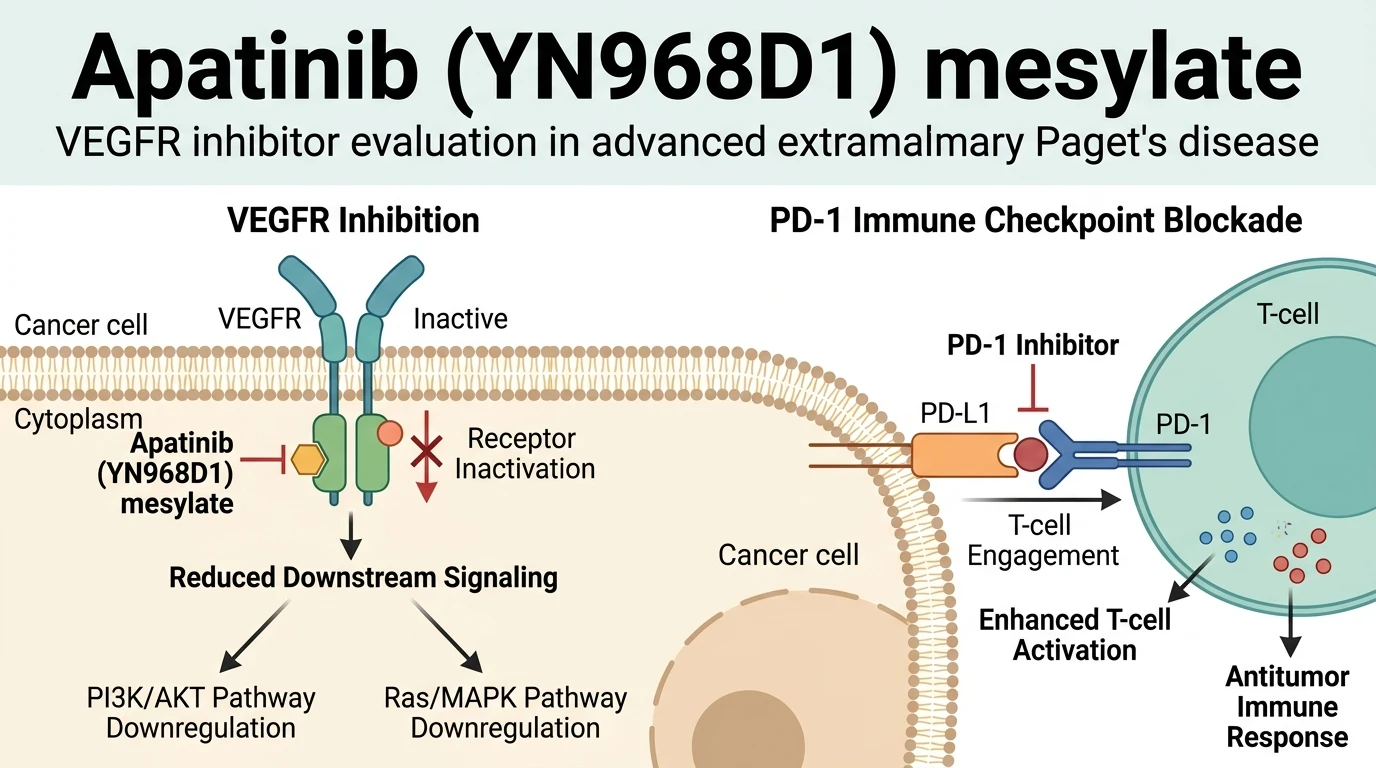
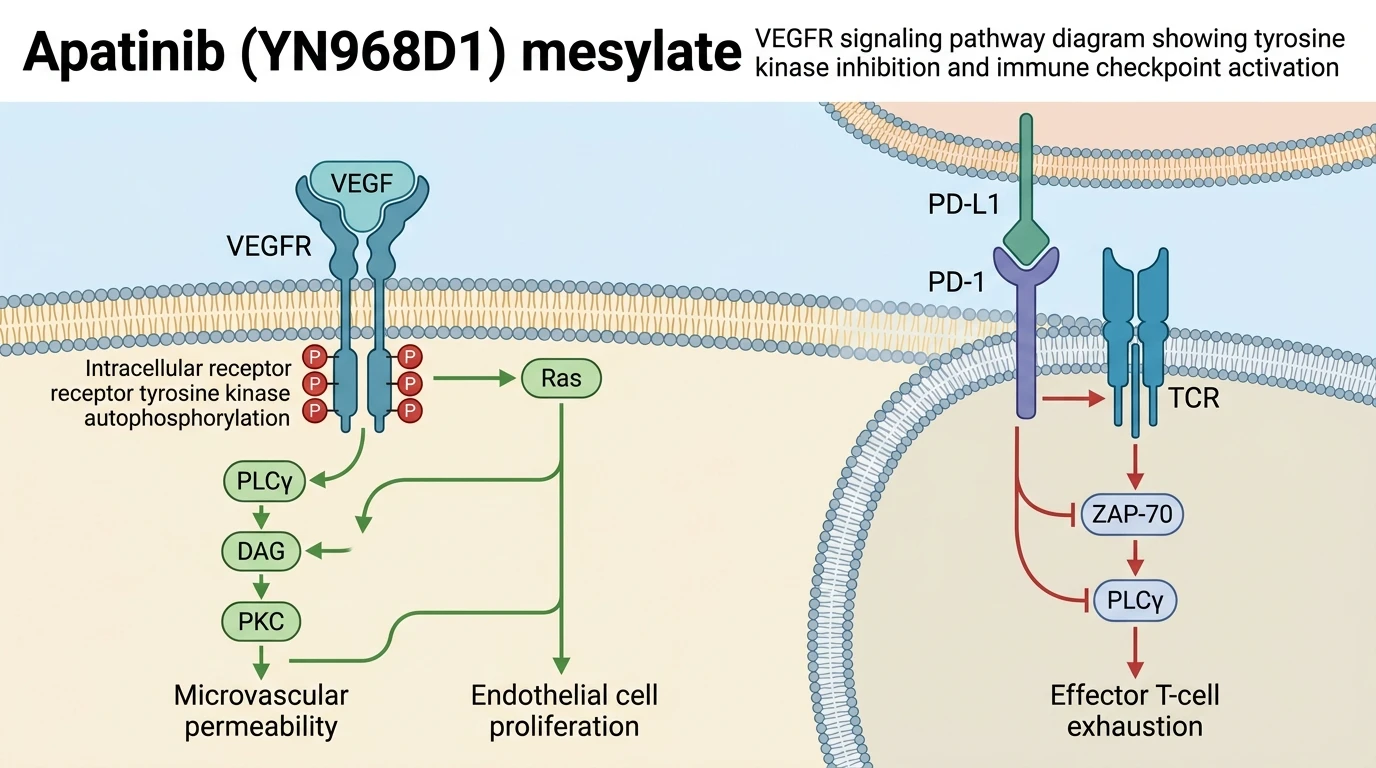
Extramammary Paget's disease (EMPD) represents a rare cutaneous adenocarcinoma that predominantly arises in apocrine gland-rich anatomical sites. Advanced or metastatic manifestations present substantial clinical challenges due to limited therapeutic options. Standard systemic cytotoxic regimens yield transient responses and noticeable hematologic toxicities. Rational combination therapies targeting distinct oncogenic signaling pathways offer a structured framework for clinical investigation. Specifically, combining vascular endothelial growth factor receptor blockade with programmed death-1 inhibition aims to disrupt tumor angiogenesis while restoring T-cell activity. VEGFR signaling driven by VEGF-A ligands promotes endothelial proliferation, vascular permeability, and capillary sprouting. Intracellular autophosphorylation of VEGFR-2 triggers downstream signaling through the RAF-MEK-ERK and PI3K-AKT cascades. Concurrently, VEGF secretion suppresses dendritic cell maturation and increases regulatory T-cell infiltration, creating a locally immunosuppressive tumor microenvironment.
Structural studies of small-molecule kinase inhibitor structures illustrate competitive binding mechanics within intracellular ATP-binding pockets. Apatinib (YN968D1) mesylate acts as a highly selective inhibitor of VEGFR-2 tyrosine kinase activity. Blocking VEGFR-2 autophosphorylation inhibits endothelial cell migration and network formation. Combining this anti-angiogenic activity with immune checkpoint blockade theoreticalizes enhanced immune cell entry into tumor nests. Camrelizumab is a humanized monoclonal antibody directed against the PD-1 receptor. By preventing PD-1 binding to PD-L1 and PD-L2, camrelizumab relieves T-cell exhaustion and restores cytotoxic activity against tumor cells.
To translate this biological rationale, a single-arm phase II clinical trial was initiated to evaluate the combination of camrelizumab and rivoceranib in patients with advanced, unresectable, or metastatic EMPD. The protocol employed a Simon two-stage design to ensure early monitoring of therapeutic response. The primary endpoint was objective response rate (ORR) assessed according to RECIST 1.1 guidelines. Secondary endpoints included progression-free survival (PFS), overall survival, and safety characterization.
Eleven evaluable patients were enrolled during the first stage of the trial. The observed clinical metrics demonstrated significant limitations in this patient population. Zero patients achieved a confirmed complete or partial response. The objective response rate remained at 0%. Median progression-free survival reached only 2.4 months. Because the predefined efficacy threshold was not met in the first stage, the study closed prematurely without progressing to stage two.
Pharmacodynamic analyses suggest that advanced EMPD biology differs substantially from angiogenic-dependent solid tumors. Genomic profiling of EMPD lesions frequently highlights alterations in the PI3K/AKT/mTOR pathway and ERBB receptor signaling, rather than high VEGF expression or elevated tumor mutational burden. Consequently, dual inhibition of VEGFR and PD-1 pathways proved insufficient to induce tumor regression in this setting. Safety metrics indicated that the regimen was well tolerated. No grade 3 or higher immune-related adverse events occurred. Common toxicities were limited to low-grade hypertension, hand-foot skin reaction, and transient proteinuria. These safety findings confirm manageable toxicity but underscore the lack of efficacy in unselected EMPD cohorts.
Pharmacological Evaluation and Clinical Outcome Analysis
Copy code to add this image to your page
Rivoceranib, administered as Apatinib (YN968D1) mesylate, selectively inhibits the intracellular kinase domain of VEGFR-2, reducing downstream endothelial signaling and microvascular formation. Concurrently, camrelizumab targets the PD-1 receptor to disrupt PD-L1 engagement, aiming to reverse T-cell exhaustion in the tumor microenvironment. Despite dual anti-angiogenic and immunomodulatory activity, clinical trial outcomes indicate that advanced extramammary Paget's disease lacks the mechanistic dependency required for objective tumor regression under this combination protocol.
Absence of Objective Responses in Advanced EMPD Cohorts
Evaluation of the phase II clinical trial data revealed an objective response rate of zero percent among eleven evaluable patients receiving dual therapy. Median progression-free survival was restricted to 2.4 months. The administration of the Apatinib (YN968D1) mesylate VEGFR inhibitor alongside camrelizumab failed to induce measurable tumor regression. Disease progression occurred rapidly in the majority of treated individuals. Consequently, the study met defined interim criteria for early termination after the first stage.
Tolerability Profile and Biomarker-Driven Stratification Implication
Treatment-emergent adverse events remained manageable throughout the study protocol. Grade 3 or higher immune-related toxicities were not observed. Nevertheless, the combination featuring the Apatinib (YN968D1) mesylate VEGFR inhibitor demonstrated insufficient single-pathway dependency in EMPD. Unselected patient populations lack the specific neoantigen landscape or vascular density required for therapeutic benefit. Future clinical trials must incorporate predictive molecular biomarkers before evaluating anti-angiogenic checkpoint combinations in cutaneous adenocarcinomas.