GSK-3484862 Non-Covalently Traps DNMT1 on Chromatin to Disrupt Epigenetic Maintenance
Copy code to add this image to your page
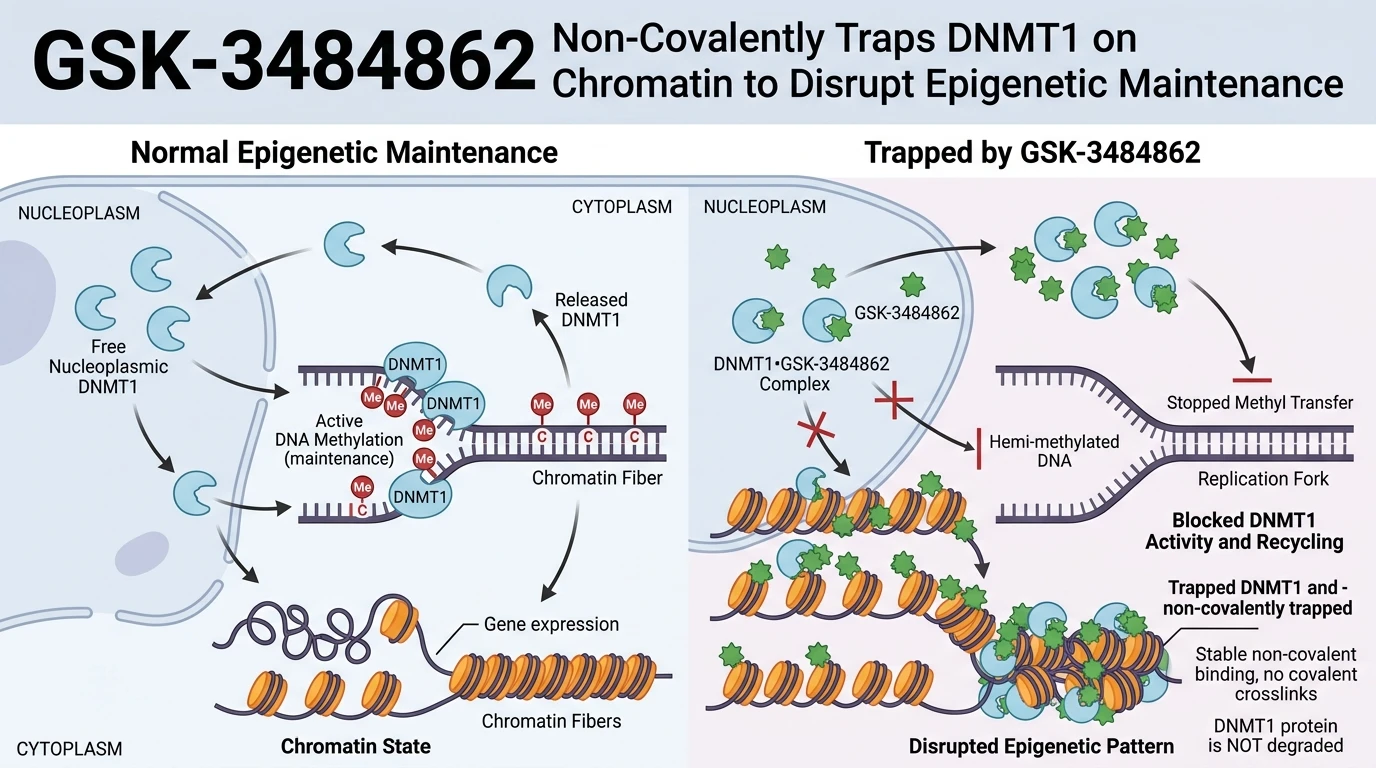
DNA methyltransferase 1 (DNMT1) serves as the primary enzymatic driver responsible for maintaining cytosine methylation patterns during mammalian DNA replication. Classically, therapeutic targeting of DNMT1 relied on nucleoside analogues such as 5-azacytidine and decitabine. These compounds require metabolic activation and covalent incorporation into nascent DNA strands to form irreversible protein-DNA adducts. However, this incorporation mechanism exhibits intrinsic myelotoxicity and depends strictly on active cell division cycles. The emergence of small-molecule, non-nucleoside inhibitors provides an alternative pharmacological strategy by engaging the catalytic or regulatory domains of DNMT1 without requiring nucleic acid integration. Among these agents, GSK-3484862 functions as a potent, non-covalent inhibitor that alters the spatial and temporal behavior of the enzyme within the nuclear architecture.
To understand how small molecules disrupt epigenetic maintenance, live-cell single-molecule tracking has clarified the baseline kinetic equilibrium of DNMT1. Under physiological conditions, DNMT1 molecules diffuse continuously through the nucleoplasm, occasionally forming transient functional complexes with chromatin. Biophysical measurements demonstrate that approximately 12% of endogenous DNMT1 molecules remain stably bound to chromatin during S phase, aligning with active DNA replication foci where hemimethylated CpG sites are presented by UHRF1. The remaining nuclear pool of DNMT1 remains highly mobile, undergoing rapid exploratory diffusion to survey genomic loci.
Acute pharmacological intervention with GSK-3484862 fundamentally alters this equilibrium. Exposure to the compound induces a rapid shift in nuclear enzyme distribution. Rather than displacing the methyltransferase into the soluble nucleoplasm, GSK-3484862 doubles the fraction of chromatin-bound DNMT1 molecules within minutes of administration. Single-molecule tracking confirms that this immobilizing event occurs well before measurable global DNA hypomethylation or proteasomal protein degradation takes place. Thus, target engagement translates immediately into non-productive chromatin trapping rather than simple physical eviction from the genome.
This trapping phenomenon mirrors aspects of the kinetic immobility observed with nucleoside analogues like 5-azacytidine, yet proceeds through a completely non-covalent binding mode. Nucleoside-derived DNA adducts physically arrest DNMT1 via covalent active-site crosslinking, triggering downstream DNA damage repair pathways and slow proteasomal clearance. In contrast, GSK-3484862 achieves rapid nuclear immobilization without establishing covalent bonds or causing immediate double-strand DNA break signaling under tested in vitro assay conditions. The non-covalent inhibitor appears to stabilize a target conformation that possesses high affinity for genomic DNA while simultaneously blocking methyl transfer capability.
The distinction between physical target degradation and functional immobilization highlights a critical nuance in epigenetic drug discovery. Traditionally, drug efficacy was correlated primarily with Western blot measurements showing depletion of total DNMT1 protein levels. However, real-time kinetic observations indicate that chromatin trapping is the primary biophysical event driving therapeutic target inhibition. By locking DNMT1 in a non-productive complex on chromatin, GSK-3484862 prevents the enzyme from migrating to newly replicated hemimethylated CpG sites. Consequently, daughter DNA strands pass through S phase unmethylated, leading to passive hypomethylation during subsequent cell divisions.
Experimental observations in human carcinoma models suggest that this non-productive relocalization from the nucleoplasm to chromatin represents an early biophysical marker of target engagement. Because this mechanism does not require genomic incorporation of drug molecules, it avoids nucleoside-associated DNA damage toxicity while maintaining high selectivity for the DNMT1 isoform. Future studies will need to clarify whether specific chromatin microenvironments or histone modification profiles modulate the residency time of these trapped complexes across diverse cell lines.
Biophysical Dynamics and Chromatin Trapping Kinetics
Copy code to add this image to your page
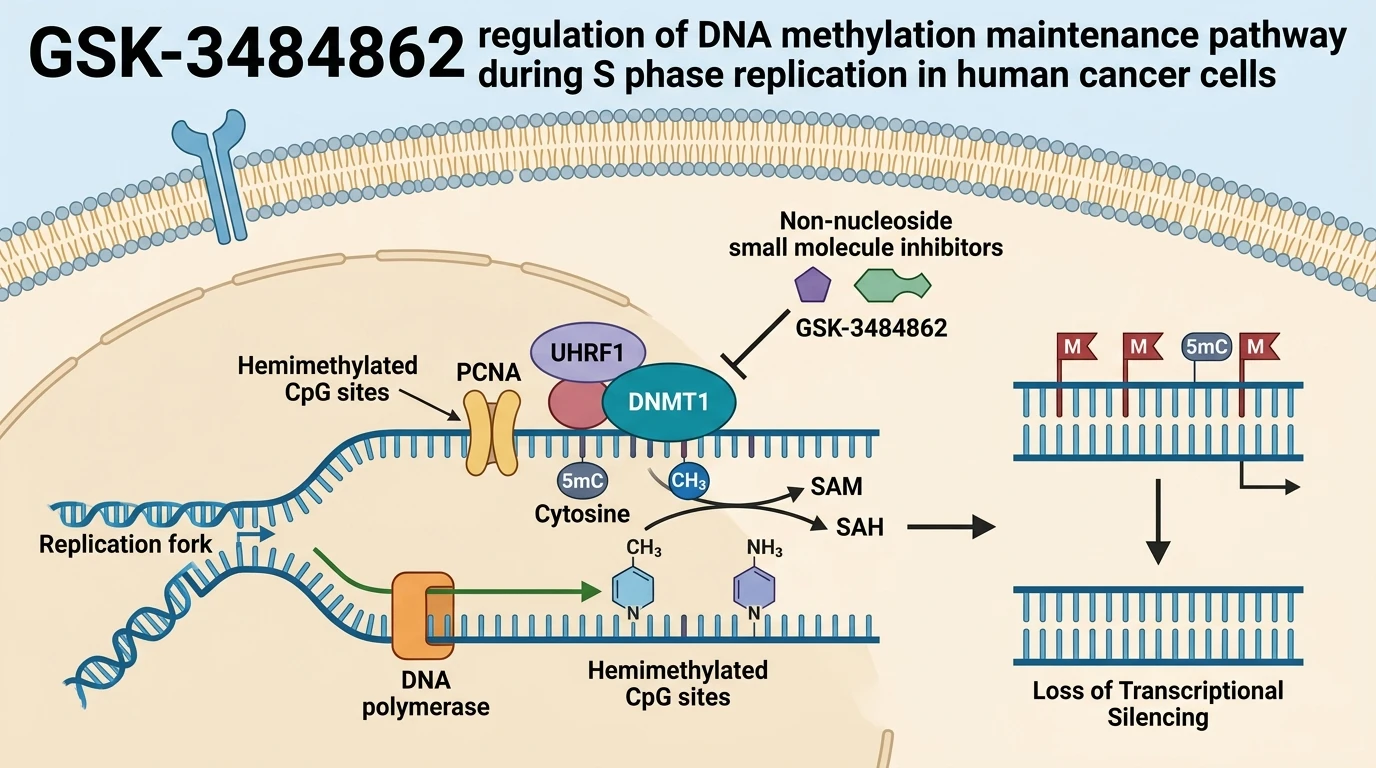
GSK-3484862 is a non-nucleoside, non-covalent inhibitor of DNMT1. It induces rapid nuclear relocalization of DNMT1 from the soluble nucleoplasm to chromatin, doubling the chromatin-bound enzyme fraction. This non-productive trapping halts methyltransferase activity at replication foci prior to global DNA hypomethylation or proteasomal protein degradation.
Acute Relocalization Traps Enzyme Prior to Proteolysis
Live-cell imaging demonstrates immediate nuclear redistribution upon drug exposure. Administration of GSK-3484862 causes DNMT1 to rapidly abandon its diffuse nucleoplasmic distribution and bind tightly to genomic DNA. The chromatin-bound fraction doubles within minutes. This rapid immobilization precedes both target degradation and global DNA hypomethylation in cultured cellular assays. Short-term kinetic measurements confirm that the compound locks the enzyme into non-productive genomic complexes. Consequently, catalytic methyl transfer is halted immediately upon target engagement.
Non-Covalent Binding Mimics Nucleoside Kinetic Profiles
Classical nucleoside inhibitors require DNA incorporation to arrest methyltransferase activity. In contrast, GSK-3484862 achieves comparable chromatin immobilization through a non-covalent, non-nucleoside interaction network. Single-molecule tracking reveals a striking reduction in nuclear diffusion coefficients following acute treatment. Although nucleoside analogues eventually induce proteasomal clearance via DNA-protein crosslink repair, non-covalent trapping operates independently of irreversible covalent bond formation under physiological conditions. The trapped enzyme remains immobilized on chromatin, effectively sequestering the catalytic pool away from active replication forks.