Fruquintinib (HMPL-013) targets VEGFR-1/2/3 kinases to suppress angiogenesis in colorectal cancer models
Copy code to add this image to your page
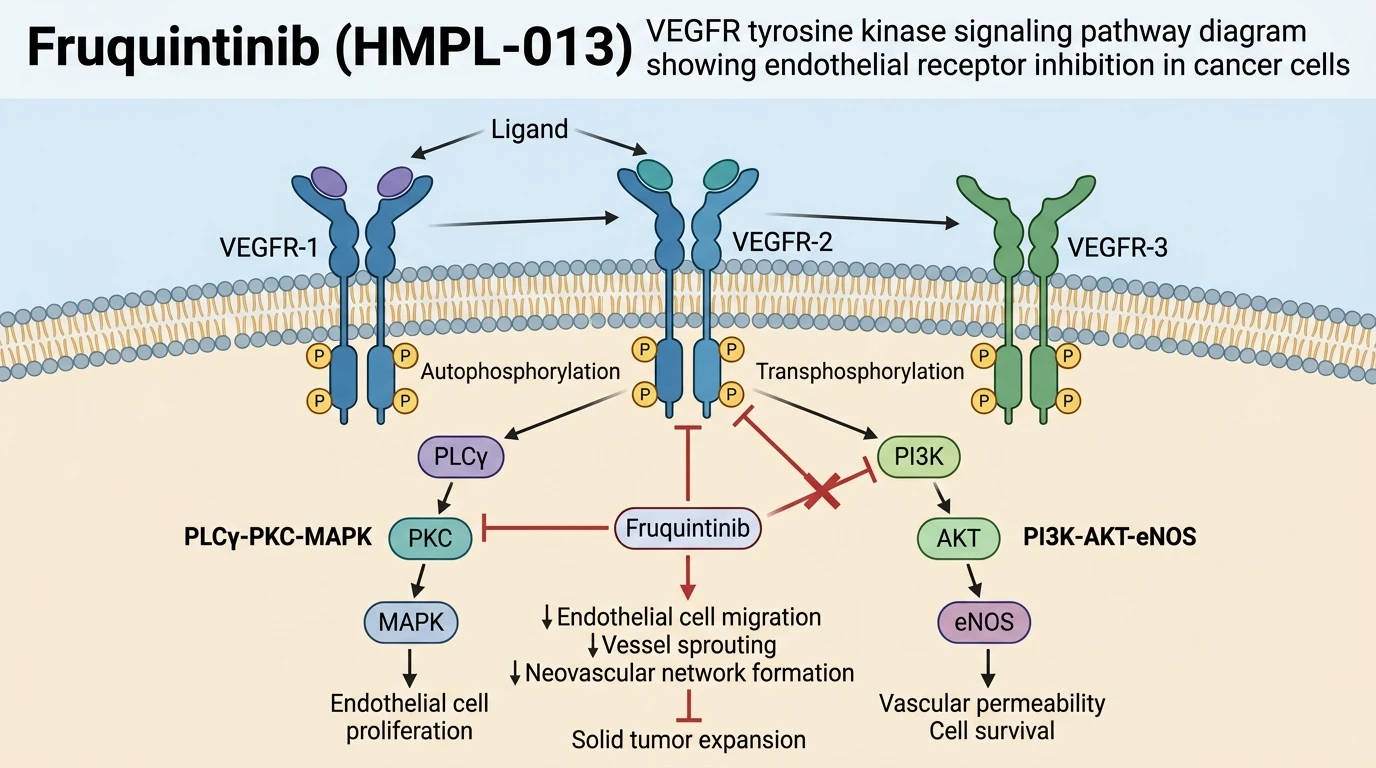
Tumor angiogenesis represents a requisite pathophysiological process for solid neoplasm expansion beyond microscopic dimensions. Among the primary signaling cascades driving vascular proliferation, the vascular endothelial growth factor receptor (VEGFR) axis serves as a central molecular axis. The receptor subfamily comprises three main receptor tyrosine kinases: VEGFR-1 (FLT-1), VEGFR-2 (KDR/FLK-1), and VEGFR-3 (FLT-4). Ligand engagement, primarily by VEGF-A, VEGF-C, and VEGF-D, triggers receptor homodimerization or heterodimerization on the plasma membrane of endothelial cells. This extracellular engagement induces trans-autophosphorylation of specific intracellular tyrosine residues within the catalytic domain, initiating downstream signal transductions including the phospholipase C-gamma (PLCγ), mitogen-activated protein kinase (MAPK), and phosphatidylinositol 3-kinase (PI3K) cascades. Activation of these pathways regulates endothelial cell survival, proliferation, directional migration, and tube formation.
Fruquintinib (HMPL-013) is an orally bioavailable, highly potent small-molecule inhibitor engineered to target the intracellular ATP-binding pockets of VEGFR-1, VEGFR-2, and VEGFR-3. By competitively preventing ATP binding, HMPL013 blocks receptor kinase domain phosphorylation, thereby halting downstream activation of secondary messenger cascades. The compound exhibits refined kinase target selectivity, displaying nanomolar inhibitory concentrations against VEGFR isoforms while minimizing off-target inhibition of unrelated receptor tyrosine kinases. This selectivity profile is intended to maximize anti-angiogenic potency while limiting systemic toxicities associated with broader kinase profiles.
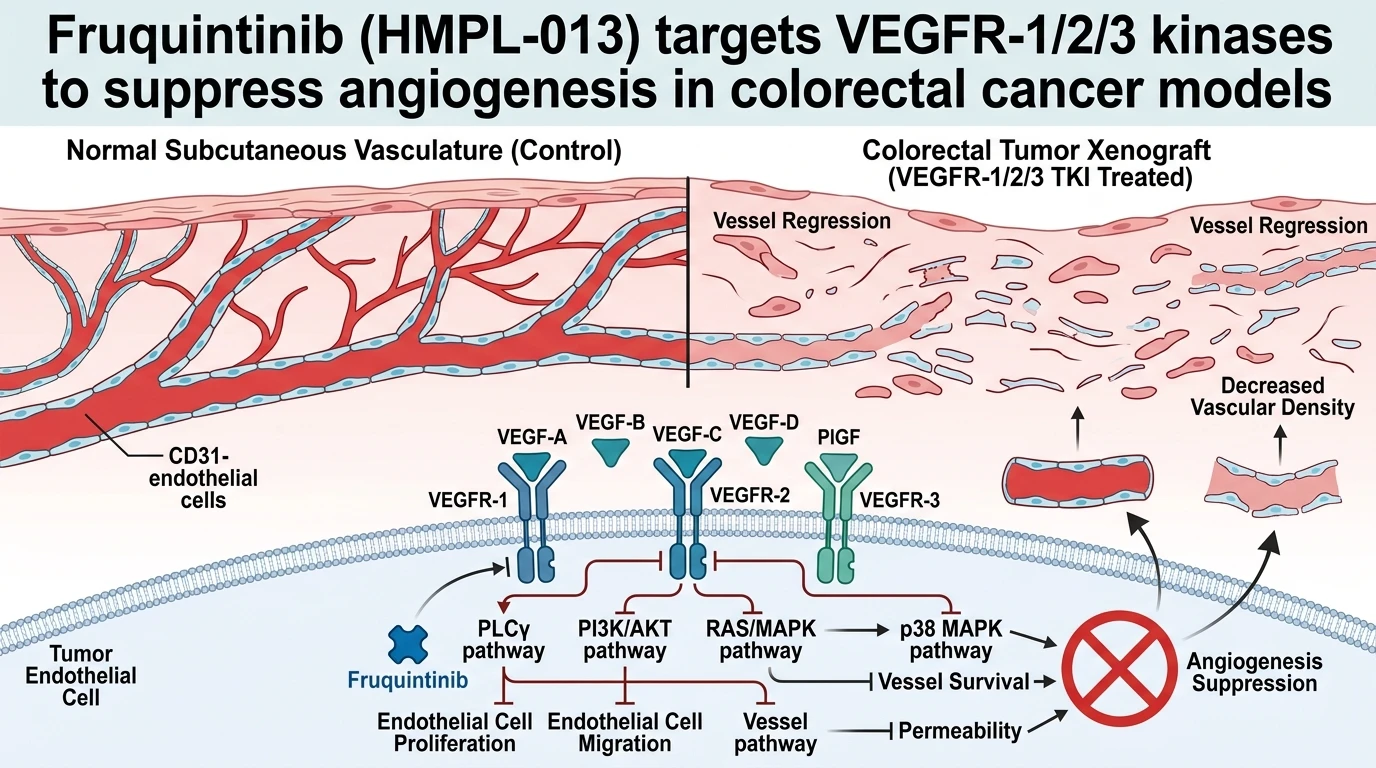
In preclinical investigations evaluating combinations against colorectal cancer, Fruquintinib (HMPL-013) was evaluated alongside the cytotoxic agent trifluridine/tipiracil (TAS-102). Therapeutic evaluations were conducted across murine xenograft models established using human colorectal cancer cell lines HCT 116 and SW48. To evaluate structural changes in tumor vasculature under single and combination dosing schedules, histopathological assessments were performed using hematoxylin and eosin (H&E) staining alongside immunohistochemical (IHC) marker analyses. Microvessel architecture was quantified using an anti-CD31 antibody, a specific marker for endothelial intercellular junctions, allowing direct visualization of microvessel density within both malignant colorectal tumor masses and surrounding non-malignant subcutaneous tissues.
Microscopic examination demonstrated that treatment regimens incorporating HMPL013 achieved substantial reduction in CD31-positive vascular lumina within HCT 116 and SW48 tumor xenografts. Quantitative vascular profiling confirmed marked decrease in microvessel density within treated tumor sections relative to vehicle controls. Morphological evaluation via H&E staining revealed areas of vascular regression, luminal collapse, and secondary intratumoral ischemic necrosis within drug-treated groups. Importantly, adjacent non-malignant subcutaneous vessels maintained normal anatomical integrity under identical experimental conditions. These empirical observations establish a structural frame for dual targeting strategies, where anti-angiogenic blockade via VEGFR-1/2/3 inhibition impairs the supporting vascular stroma while concurrent cytotoxic therapy targets the proliferating parenchymal tumor cells.
Pharmacological Inhibition of Angiogenesis and Tumor Microvessel Suppression
Copy code to add this image to your page
Fruquintinib (HMPL-013) is a potent, highly selective small-molecule inhibitor of VEGFR-1, VEGFR-2, and VEGFR-3 tyrosine kinases. By occupying the ATP-binding pocket of these receptors, it blocks VEGF-stimulated auto-phosphorylation and downstream intracellular cascades, including PLCγ-MAPK and PI3K-AKT pathways. This kinase inhibition prevents tumor-induced endothelial cell proliferation, migration, and lumen formation. In preclinical colorectal cancer models, HMPL013 reduces microvessel density, blunting tumor neovascularization and starving the neoplastic lesion of blood supply while maintaining selectivity over non-target kinases.
CD31 Staining Quantifies Microvessel Density Suppression in SW48 Models
Endothelial vessel density decreased sharply. Immunohistochemical evaluation using anti-CD31 antibodies revealed significant reduction in microvessels within SW48 colorectal xenografts treated with the combination protocol. Morphological changes were observed in H&E sections. Under these tested subcutaneous murine conditions, concurrent VEGFR-1, VEGFR-2, and VEGFR-3 target engagement by HMPL013 restricted vascular architecture development within the tumor stroma. Normal subcutaneous vessel architecture remained stable. These observations suggest that the anti-angiogenic activity selectively targets rapidly proliferating intratumoral endothelial networks rather than established physiological vasculature.
Combination Therapy Suppresses Vascularization in HCT 116 Xenografts
Tumor microvessels exhibited structural breakdown under treatment. Histopathological examination of HCT 116 colorectal tumors demonstrated disrupted vessel integrity and reduced luminal areas following combination treatment with trifluridine/tipiracil and Fruquintinib (HMPL-013). Endothelial cell survival was impaired. Inhibition of receptor autophosphorylation across VEGFR-1, VEGFR-2, and VEGFR-3 suppressed downstream angiogenic signaling cascades within the tumor microenvironment. Microvessel density dropped relative to controls. Although these preliminary preclinical findings indicate robust anti-vascular effects, clinical confirmation in patient cohorts will be required to establish therapeutic efficacy.
Kinase Target Selectivity Preserves Surrounding Subcutaneous Microvasculature
Normal vascular networks maintained structural integrity. Comparative histopathological staining of adjacent normal subcutaneous tissues confirmed minimal structural alteration, indicating preferential drug action within malignant microvessel environments. Receptor engagement remained highly targeted. By selectively blocking kinase activation in VEGFR-1, VEGFR-2, and VEGFR-3 isoforms, HMPL013 avoids widespread systemic destruction of quiescent mature vessels. Vascular regression was confined to tumor tissue. This distinct selectivity profile under preclinical assay conditions provides a clear structural framework for evaluating dual therapeutic regimens against colorectal carcinomas.