BIBR 1532 suppresses hTERT and synergizes with radiotherapy through cGAS-STING pathway activation
Copy code to add this image to your page
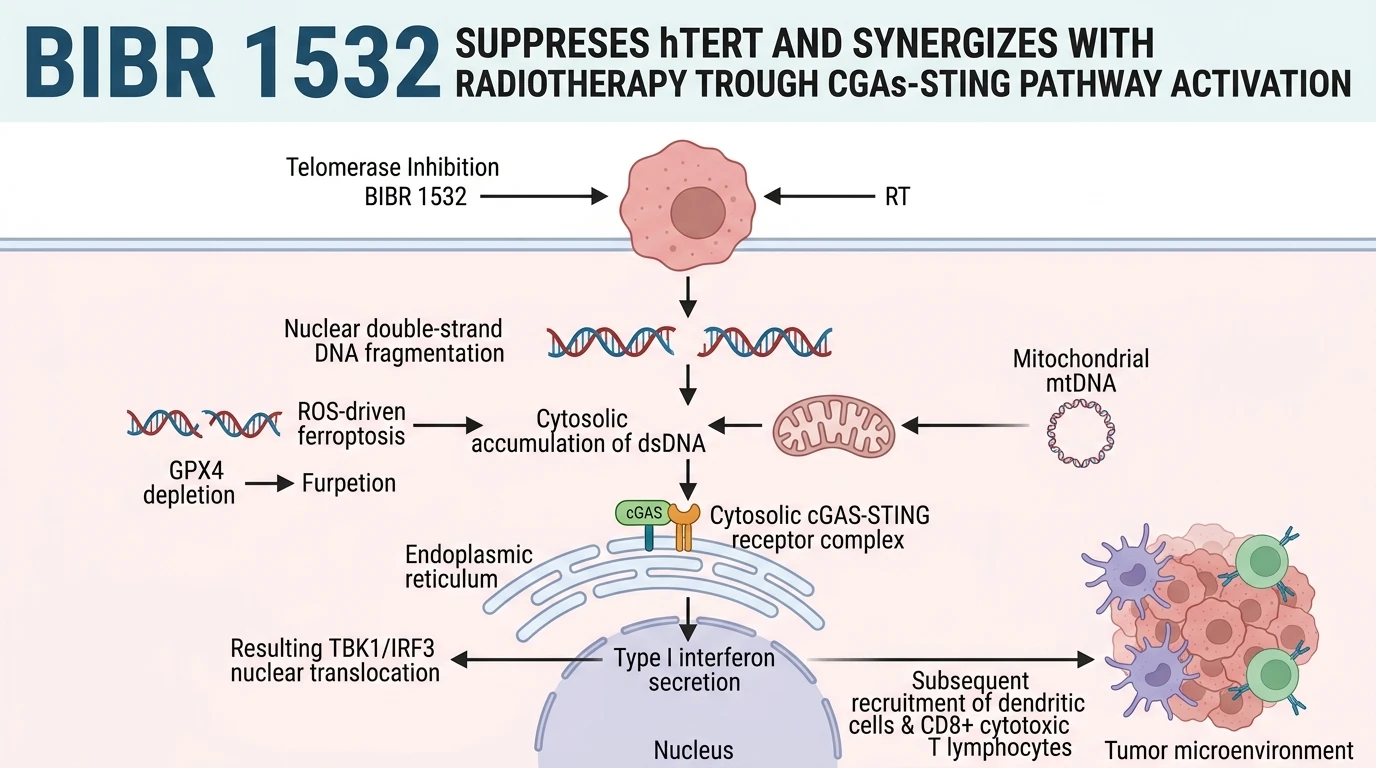
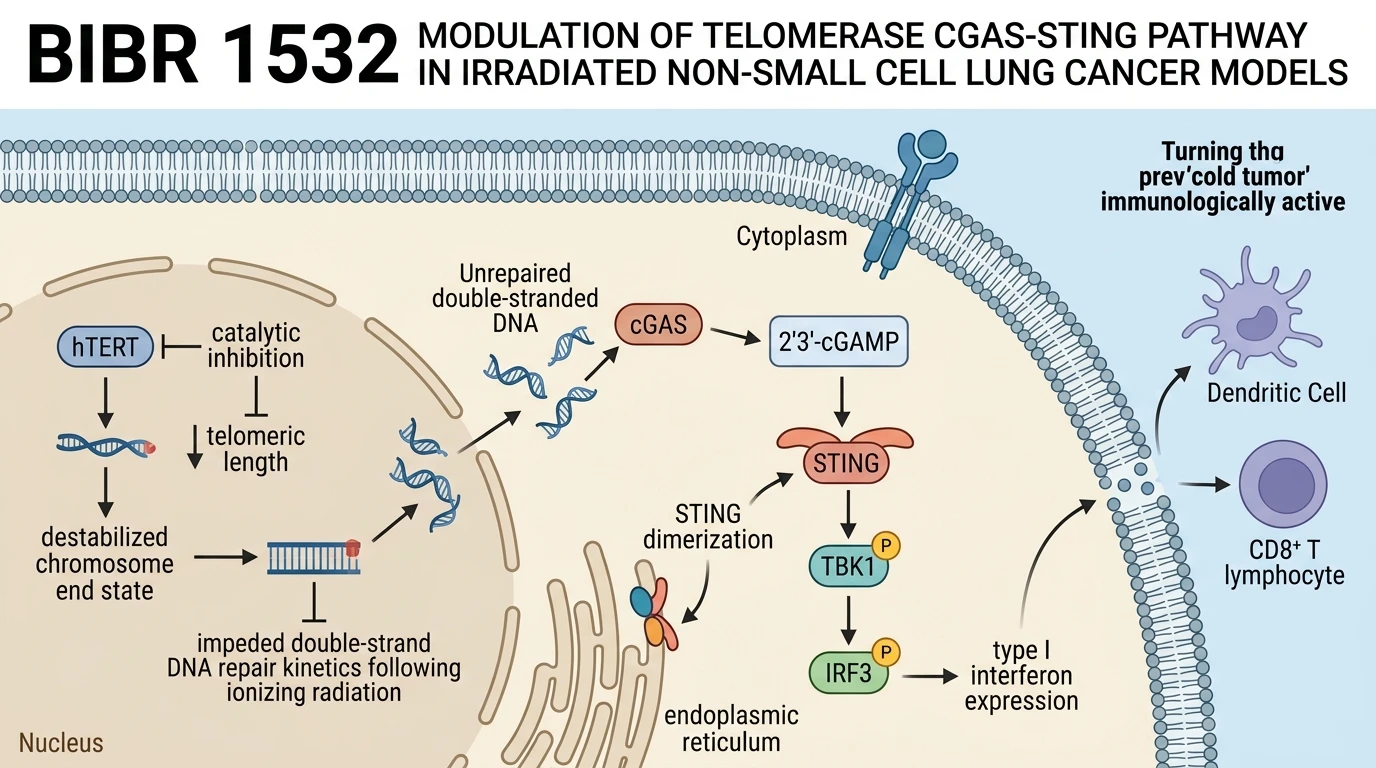
In non-small cell lung cancer (NSCLC) management, therapeutic resistance to ionizing radiation remains a major clinical obstacle. Non-nucleoside catalytic inhibition of human telomerase reverse transcriptase (hTERT) represents a targeted approach to bypass intrinsic radioresistance mechanisms. BIBR 1532 acts as a selective, non-competitive inhibitor of hTERT, binding to an allosteric hydrophobic pocket outside the catalytic reverse transcriptase domain. Telomerase activity, mediated primarily by the catalytic hTERT subunit and the RNA template TERC, is up-regulated in the majority of NSCLC malignancies to prevent telomere erosion and sustain cellular immortality. Exposure to ionizing radiation (RT) induces severe genomic stress, predominantly through ionizing events that break phosphodiester backbones to form lethal DNA double-strand breaks (DSBs). In the presence of BIBR 1532, cellular capacity to resolve radiation-induced DSBs is markedly diminished under tested in vitro and in vivo conditions. Blockade of hTERT attenuates classical non-homologous end joining and homologous recombination kinetics. This repair impairment prevents effective ligation of broken chromosomes. As broken genomic fragments break off during aberrant mitotic progression, nuclear membrane integrity deteriorates, leading to the cytosolic accumulation of damaged double-stranded DNA (dsDNA).
Simultaneously, treatment with BIBR 1532 exacerbates ionizing radiation-induced ferroptosis—an iron-dependent, non-apoptotic form of regulated cell death characterized by catastrophic lipid peroxidation. Radiation generates intracellular hydroxyl radicals through water radiolysis; BIBR 1532 treatment amplifies this oxidative cascade. Quantitative assays demonstrate a pronounced elevation of intracellular reactive oxygen species (ROS), intracellular free ferrous iron (Fe2+), and toxic lipid hydroperoxides within treated NSCLC cell lines. Pharmacological profiling reveals that this lipoperoxidative stress correlates with the depletion of reduced glutathione (GSH) reserves and a down-regulation of glutathione peroxidase 4 (GPX4) protein expression. GPX4 functions as the primary enzymatic defense suppressing phospholipid peroxidation; its suppression leads to unmitigated damage across lipid bilayers. This lipid peroxidation cascade targets mitochondrial membranes, causing loss of mitochondrial membrane potential and structural collapse of mitochondrial cristae. Consequently, mitochondrial matrix components escape into the cytoplasm, resulting in abundant release of mitochondrial DNA (mtDNA).
The resulting cytosolic pool of displaced dsDNA and mtDNA acts as an endogenous danger-associated molecular pattern (DAMP). Cytosolic nucleic acid sensors, primarily cyclic GMP-AMP synthase (cGAS), recognize these mislocalized DNA species independently of sequence specificity. Binding of dsDNA or mtDNA to cGAS induces a conformational change that catalyzes the enzymatic conversion of ATP and GTP into 2'3'-cyclic GMP-AMP (cGAMP). cGAMP functions as an endogenous second messenger, binding with high affinity to the endoplasmic reticulum membrane protein stimulator of interferon genes (STING). Upon ligand binding, STING translocates from the endoplasmic reticulum to the Golgi apparatus, recruiting TANK-binding kinase 1 (TBK1). TBK1 phosphorylates the transcription factor interferon regulatory factor 3 (IRF3), which homodimerizes and translocates into the nucleus to drive robust transcription of type I interferon genes, including IFN-alpha and IFN-beta.
Paracrine and autocrine type I interferon signaling reshapes the tumor immune microenvironment within syngeneic murine NSCLC models. Secreted type I interferons stimulate the recruitment and functional activation of CD103+ and CD11c+ dendritic cells into the tumor core. Enhanced dendritic cell maturation leads to efficient antigen processing and major histocompatibility complex class I (MHC-I) presentation to naive CD8+ T lymphocytes in draining lymph nodes. Tumor-infiltrating effector CD8+ cytotoxic T lymphocytes undergo expansion, increasing the ratio of effector T cells to immunosuppressive regulatory T cells (Tregs). To exploit this immunological priming, BIBR 1532 and ionizing radiation have been evaluated alongside programmed death-ligand 1 (PD-L1) immune checkpoint blockade. In murine xenografts, this triple combination therapy generates systemic tumor regression, impedes non-irradiated abscopal tumor growth, and markedly extends median overall survival. This multi-modal approach converts immunologically cold NSCLC lesions into inflamed, immunogenic microenvironments.
Therapeutic Evaluation and Pharmacological Characterization
Copy code to add this image to your page
BIBR 1532 selectively inhibits hTERT catalytic activity, impairing double-strand break repair and exacerbating ferroptosis during radiotherapy in NSCLC models. Radiation-induced ROS, iron accumulation, and GPX4 depletion cause severe mitochondrial damage, prompting cytosolic leakage of mtDNA and dsDNA. Mislocalized nucleic acids activate the cytosolic cGAS-STING pathway, driving type I interferon production, dendritic cell maturation, and cytotoxic CD8+ T-cell infiltration. Combining BIBR 1532 and radiation with PD-L1 blockade enhances systemic immune surveillance and survival in vivo.
Potentiation of Radiosensitivity and Cytosolic Nucleic Acid Accumulation
In cultured non-small cell lung cancer cell lines, administration of BIBR 1532 prior to gamma irradiation attenuated double-strand break repair kinetics. Neutral comet assays revealed persistent DNA tail moments 24 hours post-radiation. Fluorescence microscopy confirmed a significant increase in cytosolic double-stranded DNA foci in treated cohorts. This accumulation occurred at micromolar concentrations, demonstrating target engagement without overt off-target cytotoxicity in non-malignant bronchial epithelial controls. The suppression of DNA repair coincided with reduced catalytic activity of hTERT. Downstream phosphorylation of repair factors was markedly delayed. Cellular clonogenic survival fell sharply following combination treatment.
Ferroptosis Amplification and Mitochondrial Outer Membrane Permeabilization
Combination regimens incorporating radiation and BIBR 1532 induced profound lipid peroxidation within NSCLC models. Flow cytometric analysis utilizing C11-BODIPY probe detected elevated lipophilic ROS generation. Intracellular free iron levels increased significantly, while GSH/GSSG ratios declined rapidly. Western blotting confirmed marked down-regulation of GPX4 expression. Transmission electron microscopy illustrated mitochondrial cristae destruction and membrane rupture. These structural defects facilitated cytosolic leakage of mitochondrial DNA fragments. Co-treatment with the ferroptosis inhibitor ferrostatin-1 restored mitochondrial morphology and blunted cytosolic mtDNA accumulation in vitro.
Activation of cGAS-STING Signaling Drives Intratumoral Cytotoxic T-Cell Recruitment
In syngeneic murine NSCLC models, elevated cytosolic nucleic acid levels triggered robust cGAS-STING axis activation. Immunoblotting demonstrated enhanced phosphorylation of STING at Ser366 and TBK1 at Ser172. Quantitative RT-PCR indicated a tenfold elevation in Ifnb1 mRNA expression within isolated tumor tissue. Flow cytometry confirmed a distinct immune cell shift; mature CD86+ CD11c+ dendritic cells expanded three-fold, while infiltrating CD8+ T cells exhibited enhanced granzyme B production. Addition of anti-PD-L1 antibodies to this regimen produced complete tumor clearance in 40% of treated animals, establishing a viable strategy to enhance immunotherapeutic responsiveness in refractory malignancies.