Wnt-C59 PORCN inhibitor suppresses Wnt signaling in smoking-associated high-risk bladder cancer
Copy code to add this image to your page
Cigarette smoke exposure induces reproducible epigenetic alterations across the bladder urothelium. Chronic carcinogen exposure alters DNA methylation patterns, altering chromatin accessibility and perturbing normal transcriptional regulation in urothelial carcinoma cells. These altered epigenetic states establish distinct molecular phenotypes that correlate with disease progression, recurrence, and treatment resistance. Characterizing smoke-induced epigenetic alterations provides a framework for identifying specific biochemical dependencies that can be targeted therapeutics in stratified patient populations.
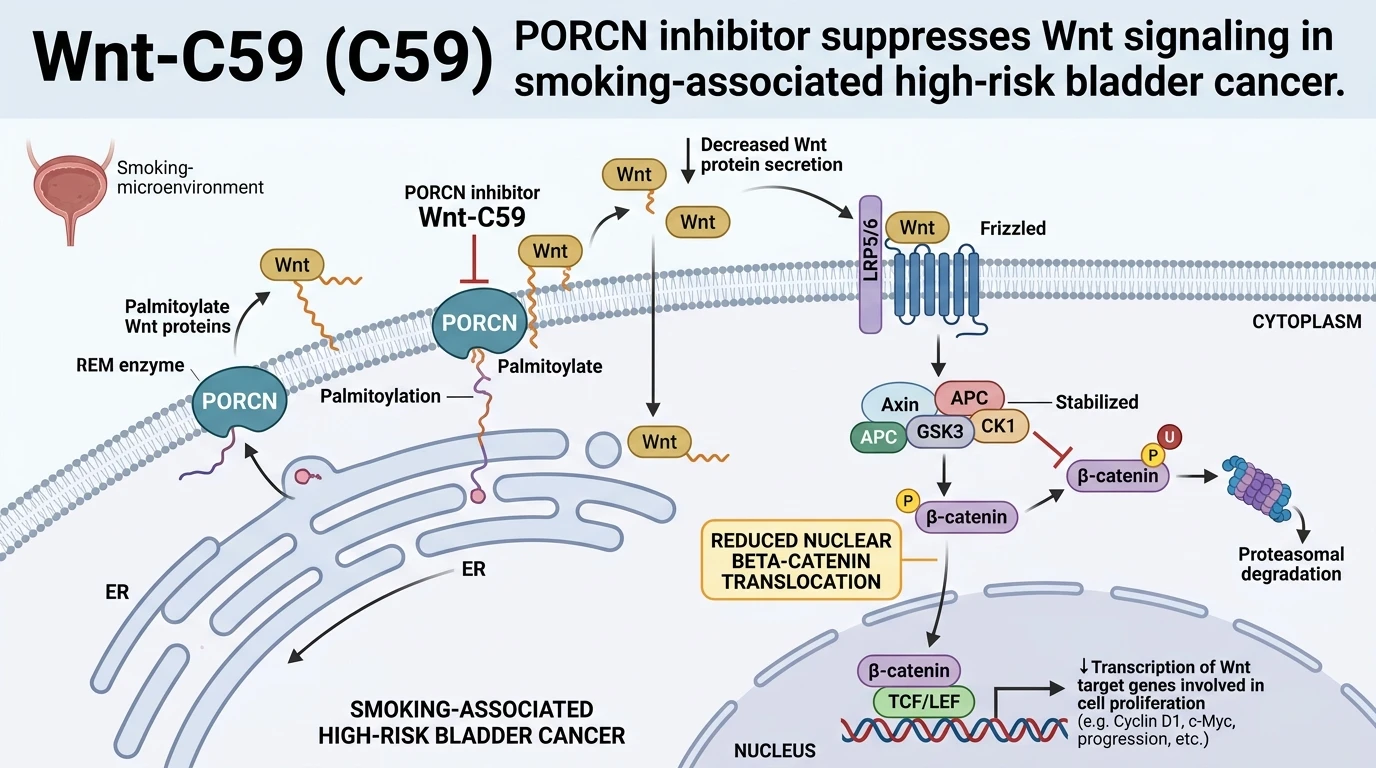
To translate these epigenetic profiles into clinical utility, recent investigation established a prognostic risk-score model derived from smoke-associated DNA methylation signatures. Patients were stratified into low-risk and high-risk cohorts based on their methylation risk scores. Gene set enrichment analysis of transcriptomic profiles revealed that high-risk tumors display pronounced activation of specific oncogenic cascades. Among these, the canonical Wnt signaling pathway exhibited significant enrichment in the high-risk cohort. In canonical Wnt signaling, extracellular Wnt ligands bind to dual receptor complexes consisting of Frizzled seven-transmembrane receptors and LRP5/6 co-receptors. Receptor engagement triggers the recruitment of Dishevelled (DVL) proteins, causing the inactivation of the intracellular destruction complex—a multiprotein assembly comprising AXIN, Adenomatous Polyposis Coli (APC), Glycogen Synthase Kinase 3 Beta (GSK3β), and Casein Kinase 1 Alpha (CK1α). Under basal conditions without ligand binding, this complex sequentially phosphorylates cytosolic β-catenin, marking it for polyubiquitination and degradation by the 26S proteasome. Pathological activation of the pathway prevents destruction complex assembly, allowing unphosphorylated β-catenin to accumulate in the cytoplasm, translocate to the nucleus, and form transcriptional complexes with TCF/LEF factors to drive oncogenic gene networks.
The functional maturation and secretion of all Wnt ligands depend upon a critical post-translational modification. Porcupine (PORCN), an O-acyltransferase located within the endoplasmic reticulum membrane, catalyzes the addition of a palmitoleate group to a conserved serine residue on Wnt proteins. This lipidation step is essential for Wnt protein trafficking from the endoplasmic reticulum to the plasma membrane via the chaperone Wntless (WLS/GPR177), as well as for binding to Frizzled receptors. Small-molecule blockade of PORCN activity effectively halts the acylation step, preventing Wnt ligand secretion and blunting downstream canonical β-catenin signaling and non-canonical planar cell polarity pathways. Molecular characterization of PORCN interactions can be referenced through PORCN ligand structural profiles in structural databases. The compound Wnt-C59 (C59), acting as a highly potent Wnt-C59 PORCN inhibitor, targets this enzymatic bottleneck with sub-nanomolar affinity.
To evaluate therapeutic responsiveness, drug sensitivity analysis was performed using the oncoPredict computational package applied to clinical transcriptomic cohorts. The algorithm mapped baseline gene expression profiles against verified cell line drug screening databases to calculate predicted half-maximal inhibitory concentration (IC50) values. The analysis demonstrated that tumors in the smoking-associated high-risk group exhibited significantly lower predicted IC50 values for Wnt-C59 (C59) than those in the low-risk group. This sensitivity differential reflects the heightened baseline dependency on Wnt signaling observed in high-risk, smoke-damaged urothelium.
Pharmacological inhibition of PORCN using Wnt-C59 (C59) offers a biomarker-driven therapeutic strategy for high-risk bladder cancer. By blocking ligand acylation at its enzymatic source, Wnt-C59 deprives the tumor microenvironment of functional autocrine and paracrine Wnt signals. These observations highlight how epigenetically defined high-risk patient subsets can be matched to targeted signaling inhibitors, though translational validation in patient-derived models remains necessary.
Pharmacological Profiling and Stratified Therapeutic Responsiveness
Copy code to add this image to your page
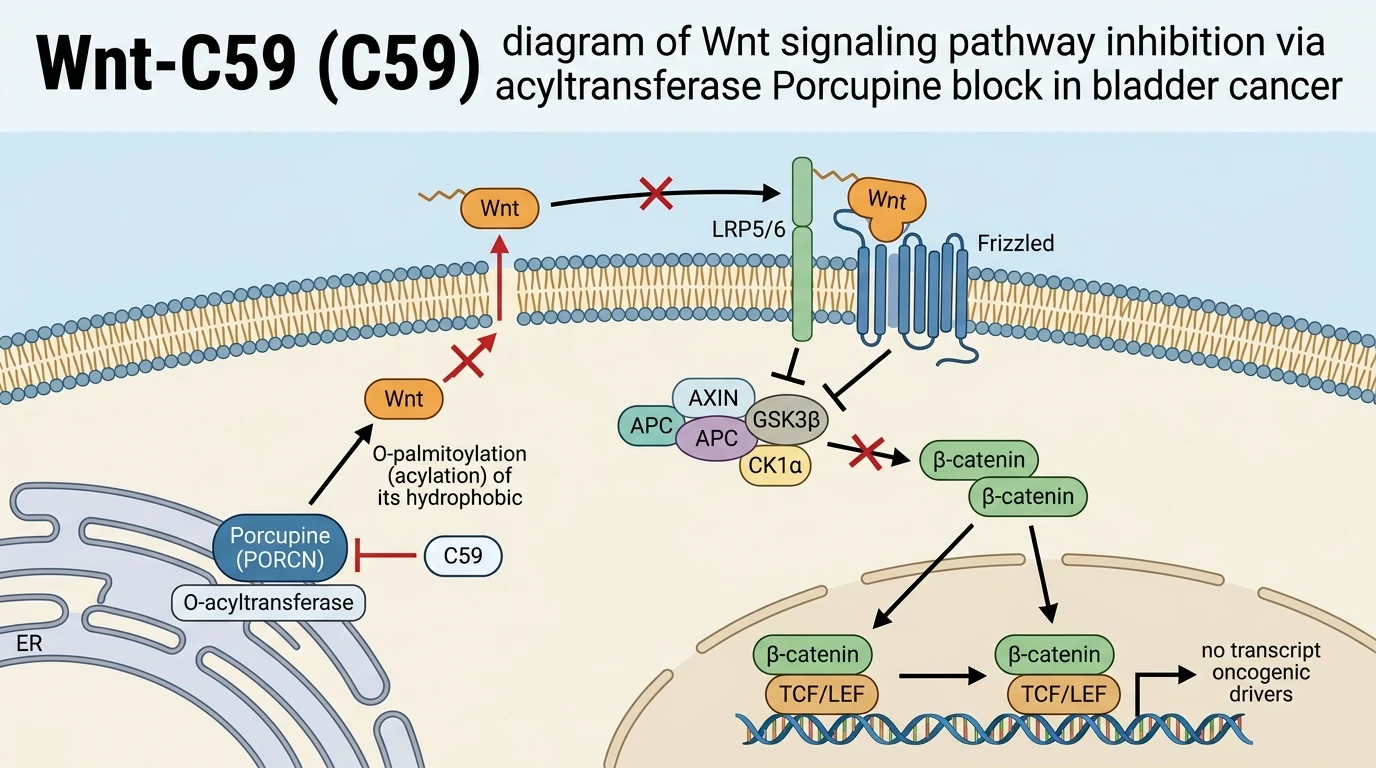
Wnt-C59 (C59) is a potent, selective inhibitor of Porcupine (PORCN), an essential membrane-bound O-acyltransferase required for Wnt ligand palmitoylation and secretion. By blocking PORCN activity, Wnt-C59 prevents post-translational modification of Wnt proteins, impairing canonical β-catenin accumulation and downstream oncogenic transcription. In smoking-associated bladder cancer, high-risk epigenetic profiles exhibit marked enrichment of Wnt signaling. Targeted PORCN inhibition via Wnt-C59 disrupts autocrine signaling loops, blunting tumor viability in stratifiable high-risk patient subsets.
Epigenetic Risk Stratification Dictates Wnt Dependency
Epigenetic profiling reveals clear patient subgroup divergence. In patient-derived transcriptomic datasets, smoke-associated DNA methylation patterns correlate directly with elevated transcript levels of Wnt ligands and Frizzled receptors. Biological dependency on signaling cascades increased significantly. Stratification through prognostic risk-score algorithms confirmed that high-risk tumors maintain active β-catenin nuclear localization under basal conditions. The low-risk cohort lacked this pathway enrichment. Consequently, malignant cell proliferation in high-risk bladder urothelial carcinoma relies heavily upon continuous autocrine ligand stimulation.
PORCN Blockade Arrests Ligand Acylation and Secretion
Enzymatic acylation controls Wnt ligand maturation. Administration of the Wnt-C59 PORCN inhibitor interrupts palmitoylation within the endoplasmic reticulum, preventing interaction with the secretory protein Wntless. Unmodified Wnt ligands accumulate intracellularly. Deprived of extracellular ligands, receptor complex phosphorylation ceases, which allows the destruction complex to ubiquitinate cytosolic β-catenin. Nuclear gene expression drops markedly. Under tested in vitro assay conditions, treatment with Wnt-C59 (C59) restored GSK3β-mediated degradation kinetics within hours.
Predictive Modeling Highlights High-Risk Sensitivity Margins
Computational drug sensitivity metrics established marked divergence. Utilizing the oncoPredict algorithmic package, baseline expression profiles were mapped against verified cell line drug response databases to estimate IC50 metrics. The sensitivity differential remained statistically robust. Tumors classified within the smoking-associated high-risk category demonstrated lower estimated IC50 values compared to their low-risk counterparts. Target selectivity was maintained across cohorts. These predictive observations indicate that high-risk bladder cancer patients represent the primary candidate population for targeted PORCN inhibition therapy.