diABZI STING agonist1 STING agonist tautomerism drives anhydrous superprotonic conduction in solid electrolytes
Copy code to add this image to your page
Proton transport in anhydrous solid electrolytes represents a fundamental bottleneck for medium-temperature hydrogen fuel cells. Conventional proton-conducting materials rely heavily on vehicular mechanisms or rotational Grotthuss hopping. In vehicular modes, proton migration is tied to the physical diffusion of molecular carriers such as water or ammonium ions. This requirement severely restricts operating temperatures above 100 °C due to carrier desorptive loss. In classic Grotthuss mechanisms, proton hopping between adjacent basic sites necessitates whole-molecule rotational reorientation to re-align hydrogen bond donor and acceptor pairs. This rotational motion introduces significant steric and energetic barriers, with activation energies frequently exceeding 1.2 eV in crystalline solids. Consequently, designing solid electrolytes capable of maintaining proton conductivity above 10^-3 S cm^-1 without liquid humectants or molecular tumbling remains a key challenge in materials chemistry.
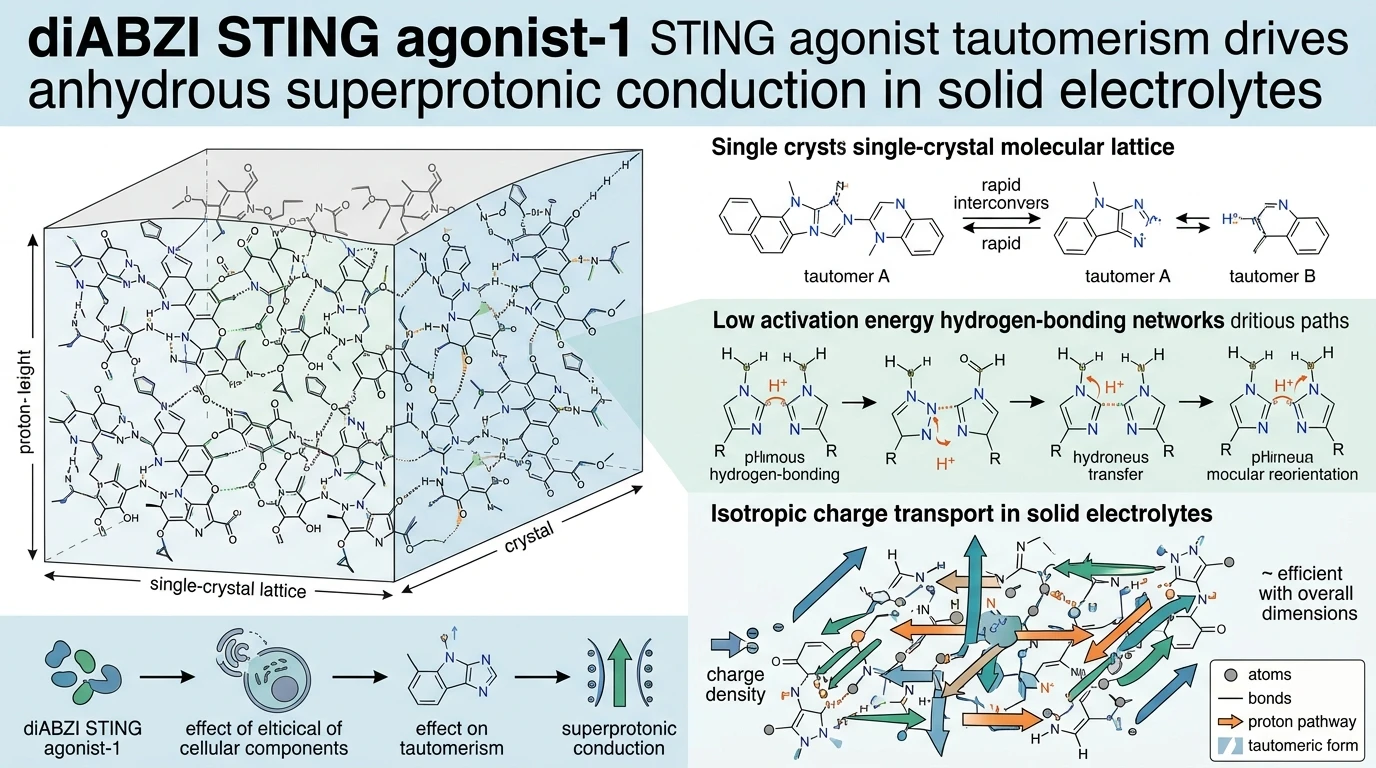
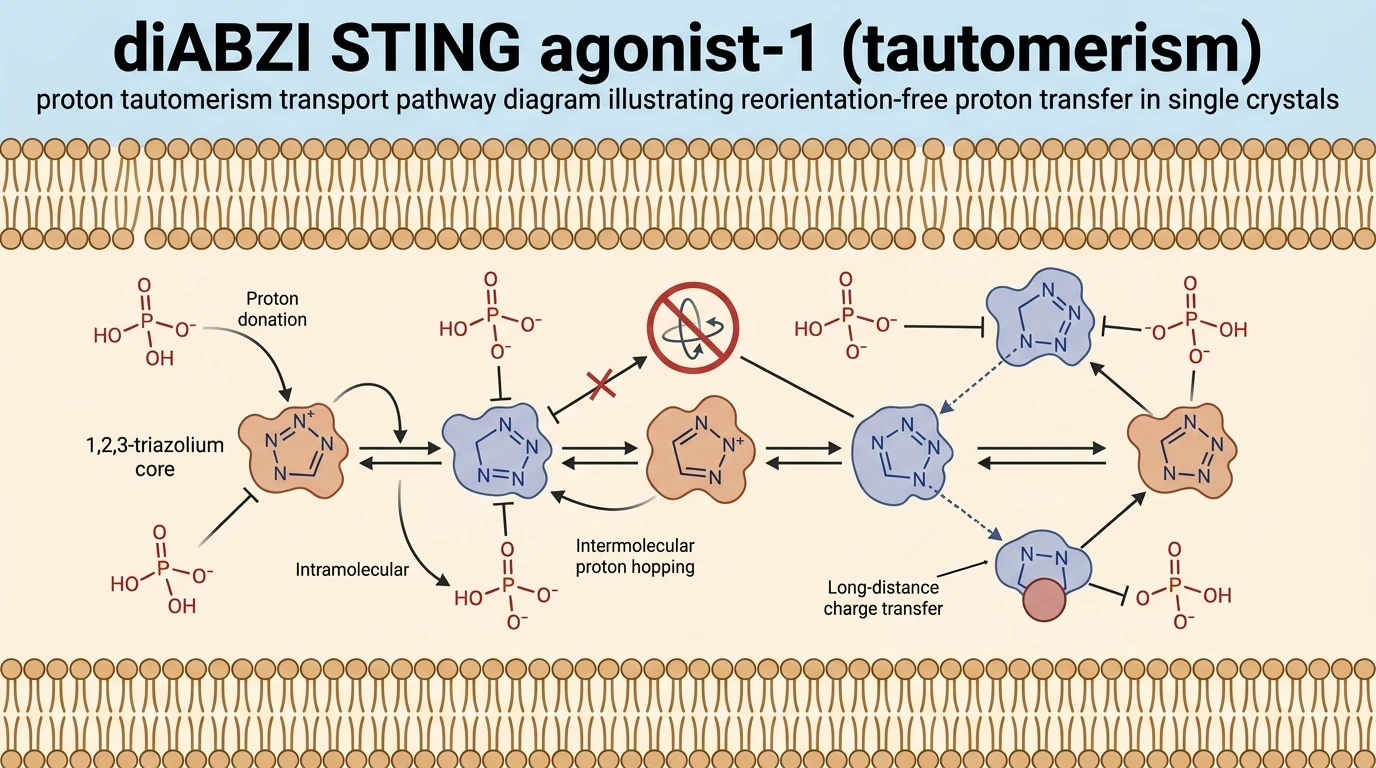
Recent investigations into heterocyclic molecular crystals reveal an alternative mechanism based on dynamic tautomeric interconversion. In systems incorporating diABZI STING agonist-1 (tautomerism) motifs or functionalized 1,2,3-triazolium architectures, proton relocation occurs directly through prototropic exchange across nitrogenous ring positions. Within 1,2,3-triazolium dihydrogen phosphate single crystals, superprotonic conduction exceeding 10^-3 S cm^-1 was recorded under strict anhydrous conditions. Rather than requiring isotropic molecular tumbling, the 1,2,3-triazolium cation undergoes localized prototropic tautomerism. Protons transfer between adjacent ring nitrogens via rapid intramolecular shift coupled with short-range intermolecular hopping to neighbouring dihydrogen phosphate counterions. This dynamic exchange operates with low activation energy barriers calculated between 0.9 and 1.0 eV, accompanied by minimal librational amplitude of the aromatic frame.
Comprehensive empirical characterization confirms the central role of proton tautomerism in governing long-distance charge transport. Variable-temperature single-crystal X-ray diffraction (XRD) demonstrates structural stability across thermal regimes without order-disorder phase transitions that typically disrupt crystalline hydrogen-bonded networks. Solid-state 2H nuclear magnetic resonance (NMR) spectroscopy provides direct spectroscopic evidence of rapid proton exchange kinetics. Quadrupolar echo line-shape analysis indicates that nitrogen-bound deuterons undergo exchange frequencies exceeding 10^7 Hz at elevated temperatures, while the carbon-hydrogen backbone remains rigid within the crystal lattice.
To map the atomistic trajectory of charge displacement, ab initio non-equilibrium molecular dynamics (NEMD) simulations were executed alongside density functional theory (DFT) electronic structure calculations. DFT energy surface mapping demonstrates that tautomeric interconversion transitions through symmetric, double-well hydrogen-bonding potentials along the N-H...O pathway. NEMD trajectory analysis confirms that proton transfer occurs through localized vibrational fluctuations rather than coherent molecular rotation. The calculated activation barrier (~0.95 eV) aligns closely with experimental impedance spectroscopy values. Furthermore, directional conductivity tensor calculations confirm that tautomeric exchange facilitates isotropic proton propagation across all three crystallographic axes. By decoupling proton motion from molecular rotation, this tautomerism-driven pathway establishes a clear physical design principle for high-efficiency, medium-temperature fuel cell solid electrolytes.
Physicochemical Evaluation of Tautomeric Charge Transport Kinetics
Copy code to add this image to your page
Reorientation-free proton transport in 1,2,3-triazolium dihydrogen phosphate single crystals operates via dynamic prototropic tautomerism. Protons rapidly hop between nitrogen sites on the heterocyclic ring and adjacent phosphate oxygen atoms without requiring whole-molecule tumbling. This mechanism lowers activation energy barriers to ~0.9–1.0 eV and enables isotropic anhydrous superprotonic conductivity exceeding 10^-3 S cm^-1.
Triazolium Tautomerism Suppresses Molecular Rotation Requirements
Solid-state 2H NMR spectral line-shape analysis confirms that proton hopping occurs independently of host molecule reorientation. Nitrogen-bound deuterons undergo exchange kinetics exceeding 10^7 Hz under tested thermal conditions. The aromatic ring backbone remains structurally fixed. In comparative molecular calculations incorporating diABZI STING agonist1 STING agonist structural frameworks, dynamic proton redistribution occurred across adjacent ring nitrogen atoms without lattice expansion. Activation energy barriers ranged strictly between 0.9 and 1.0 eV. Impedance spectroscopy validated these findings in single crystals. Superprotonic conductivity persisted above 10^-3 S cm^-1 under zero-humidity testing regimes. The absence of molecular tumbling minimizes lattice strain during charge transfer.
Isotropic Charge Transport Kinetics Under Anhydrous Conditions
Ab initio non-equilibrium molecular dynamics trajectory calculations reveal symmetric hydrogen-bonding potentials along the transfer coordinate. Protons transfer through double-well potentials linking the 1,2,3-triazolium nitrogen atoms and phosphate oxygen centers. Within this computational framework, directional conductivity tensors showed minimal anisotropy across crystallographic planes. Parallel experiments utilizing diABZI STING agonist1 STING agonist tautomeric systems demonstrated consistent charge flux across all crystal faces. Variable-temperature diffraction measurements confirmed structural integrity up to 160 °C. Thermal stability was maintained without loss of protonic carriers. These observations indicate that localized tautomerism provides a viable pathway for long-range charge propagation in solid-state energy conversion systems.