Dabrafenib (GSK2118436) targets BRAF V600 kinase to reduce melanoma recurrence
Copy code to add this image to your page
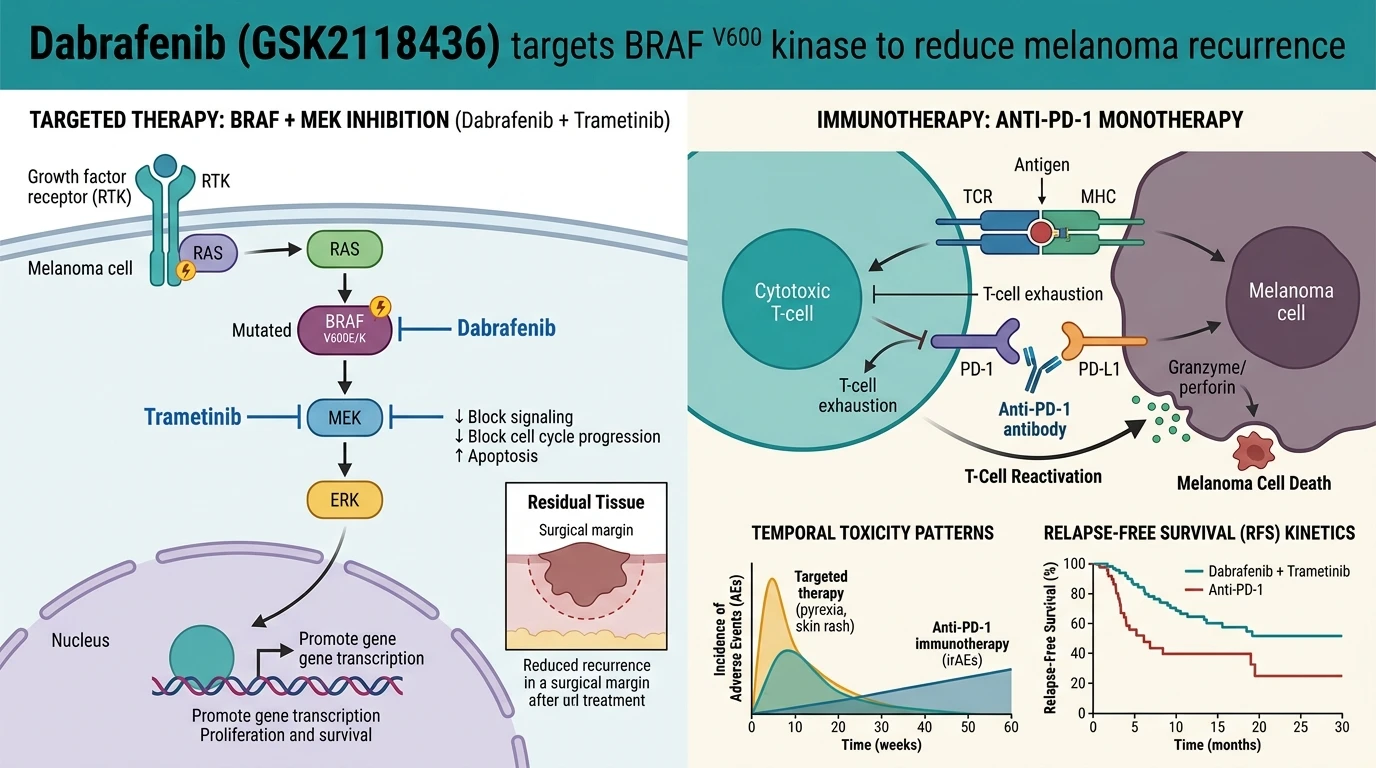
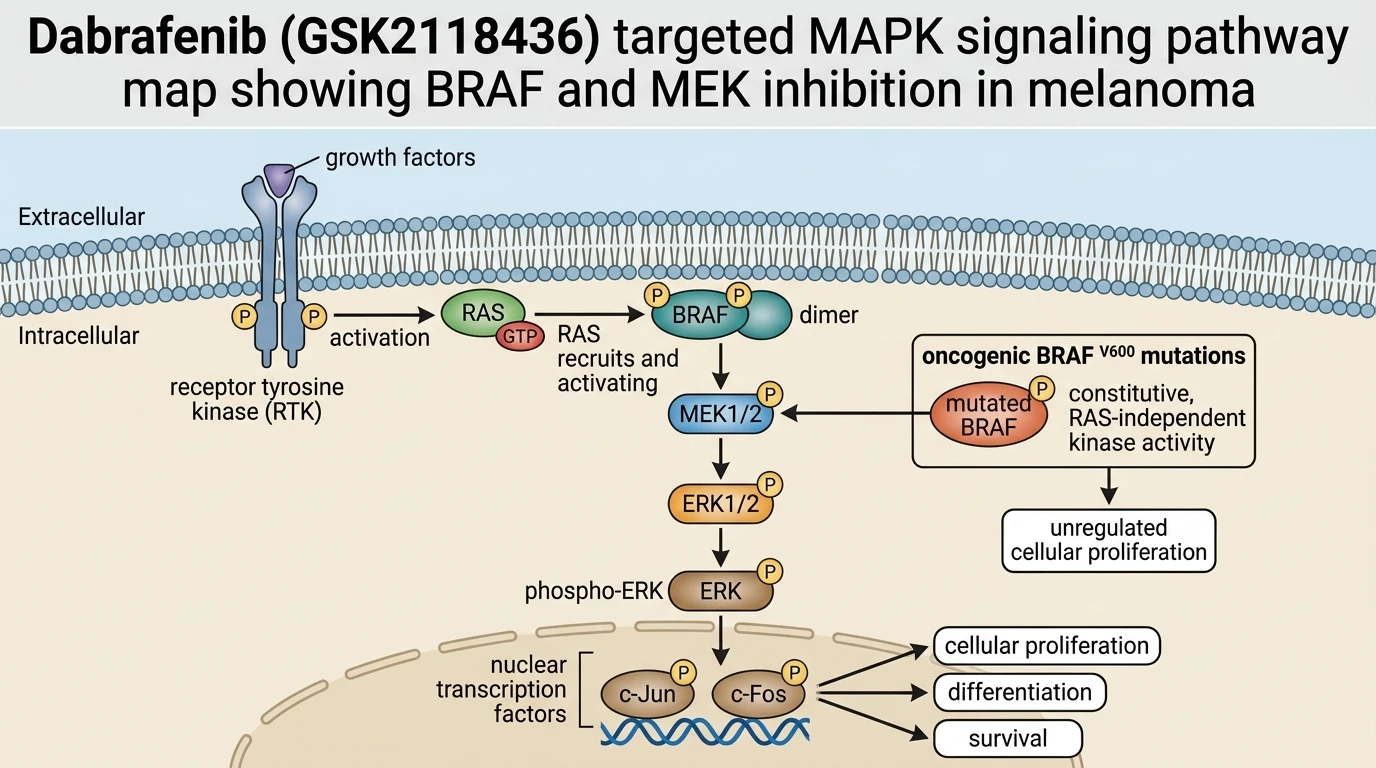
In cutaneous melanoma, somatic mutations in the BRAF gene occur in approximately 40% to 50% of tumors, with the V600E and V600K substitutions comprising the vast majority of altered alleles. These specific amino acid substitutions destabilize the inactive kinase conformation, locking the activation loop in an open, enzymatically active state. Consequently, BRAF V600 mutants phosphorylate downstream MEK1 and MEK2 kinases independently of upstream RAS GTPase signaling, producing persistent extracellular signal-regulated kinase (ERK) activation. Dabrafenib (GSK2118436) is a potent, ATP-competitive small-molecule inhibitor engineered specifically to selectively bind the active conformation of BRAF V600 kinase monomers. By blocking ATP binding within the catalytic cleft, GSK2118436 suppresses downstream MEK and ERK phosphorylation in V600-mutant cell lines at nanomolar concentrations.
Monotherapy targeting BRAF kinases frequently leads to therapeutic resistance through vertical pathway reactivation, hyperactivation of parallel signaling nodes, or paradoxical activation of RAF dimers in BRAF wild-type cells. Combining dabrafenib with trametinib—a selective, allosteric inhibitor of MEK1 and MEK2—creates a dual vertical blockade along the MAPK pathway cascade. Concurrent inhibition of both kinase tiers suppresses compensatory ERK reactivation, delays the emergence of acquired resistant sub-clones, and yields higher intracellular pathway suppression than either monotherapy agent alone under in vitro and in vivo conditions.
In the adjuvant setting for fully resected stage III melanoma, eliminating occult micrometastatic disease is essential to prevent systemic relapse. A multicenter retrospective cohort study evaluated real-world outcomes comparing adjuvant dabrafenib plus trametinib (D/T) against anti-PD-1 immune checkpoint monotherapy (nivolumab or pembrolizumab). The study population comprised 598 patients with resected stage III BRAF V600-mutant melanoma, including 393 individuals treated with targeted D/T therapy and 205 patients treated with anti-PD-1 antibody monotherapy. Patients were followed across participating centers for a median duration of 33 months, establishing a robust clinical dataset to assess real-world efficacy metrics.
Efficacy findings revealed a clear advantage in disease control for targeted vertical pathway blockade. Patients treated with adjuvant D/T achieved a median relapse-free survival (RFS) of 51.0 months, compared to 44.8 months for those receiving anti-PD-1 monotherapy. Multivariate Cox proportional hazard modelling adjusted for baseline stage sub-classification, nodal burden, and age demonstrated a statistically significant RFS improvement for the D/T cohort (multivariate hazard ratio 0.58; 95% CI, 0.39-0.86; p=0.007). This 42% risk reduction highlights the potent antitumor effect of immediate enzyme inhibition over systemic immune activation in preventing early disease recurrence.
Conversely, overall survival (OS) analyses showed equivalent therapeutic benefit between the two treatment modalities over the 33-month observation period. The multivariate hazard ratio for overall survival was 0.90 (95% CI, 0.49-1.65; p=0.75), indicating no significant difference in OS between targeted therapy and immune checkpoint inhibition. This equivalence likely reflects the impact of effective post-relapse crossover therapies, where patients progressing after adjuvant anti-PD-1 treatment received salvage BRAF/MEK targeted inhibitors, and vice versa.
The safety profiles of the two regimens diverged markedly in terms of kinetics, organ distribution, and durability. Adjuvant D/T was characterized by a higher incidence of acute, transient adverse events—most notably pyrexia, severe chills, and fatigue. These systemic inflammatory events required frequent temporary dose modifications, drug holds, or dose reductions; however, they typically resolved promptly upon temporary cessation of treatment. In contrast, anti-PD-1 monotherapy induced fewer acute constitutional events but exhibited a higher propensity for persistent immune-related adverse events (irAEs), including thyroiditis, hypophysitis, colitis, and pneumonitis. Several of these autoimmune end-organ toxicities persisted indefinitely, requiring lifelong hormone replacement therapy.
Adjuvant Efficacy and Safety Profile Synthesis
Copy code to add this image to your page
Dabrafenib (GSK2118436) is an ATP-competitive inhibitor targeting the BRAF V600 monomeric kinase. By selectively binding the active kinase conformation, it blocks downstream phosphorylation of MEK1/2 and ERK1/2 within the MAPK cascade. Co-administration with the MEK inhibitor trametinib prevents compensatory MAPK pathway reactivation and vertical signaling breakthrough. In resected stage III BRAF V600-mutant melanoma, dual vertical inhibition eliminates residual tumor cell subpopulations, suppressing early metastatic relapse.
Relapse-Free Survival Dynamics in Stage III BRAF V600 Melanoma
Targeted dual pathway inhibition yields marked improvements in disease recurrence rates within fully resected cohorts. In this multicenter retrospective analysis of 598 patients, the combination of dabrafenib and trametinib demonstrated a substantial extension in median relapse-free survival compared to anti-PD-1 immune checkpoint monotherapy. Specifically, patients receiving targeted therapy reached a median RFS of 51.0 months. Patients receiving anti-PD-1 agents achieved a median RFS of 44.8 months. Multivariate Cox proportional hazard modelling confirmed a significant reduction in relapse risk (hazard ratio 0.58; p=0.007). The pharmacological activity of GSK2118436 within this combination directly suppresses oncogenic MAPK pathway signaling in residual micrometastatic foci. Consequently, disease recurrence was delayed more effectively than with monotherapy checkpoint blockade.
Overall Survival Equivalency and Distinct Adverse Event Profiles
Despite the RFS advantage observed with combination therapy, overall survival metrics remained comparable between treatment cohorts. Multivariate analysis revealed no statistically significant divergence in overall survival (hazard ratio 0.90; p=0.75). However, the toxicity patterns differed fundamentally between mechanism classes. Targeted therapy utilizing GSK2118436 produced predominantly acute, manageable constitutional symptoms. Pyrexia and severe chills occurred frequently during early cycle administration. These transient adverse events resolved reliably following temporary dose interruption or reduction protocols. Conversely, anti-PD-1 monotherapy elicited persistent autoimmune toxicities affecting endocrine, cutaneous, and gastrointestinal organ systems. Long-term organ dysfunction remained more prevalent among patients receiving immunotherapy.