2-Bromohexadecanoic acid (2-BP) from Selleck targets Cas9 DSB site indel resolution
Copy code to add this image to your page
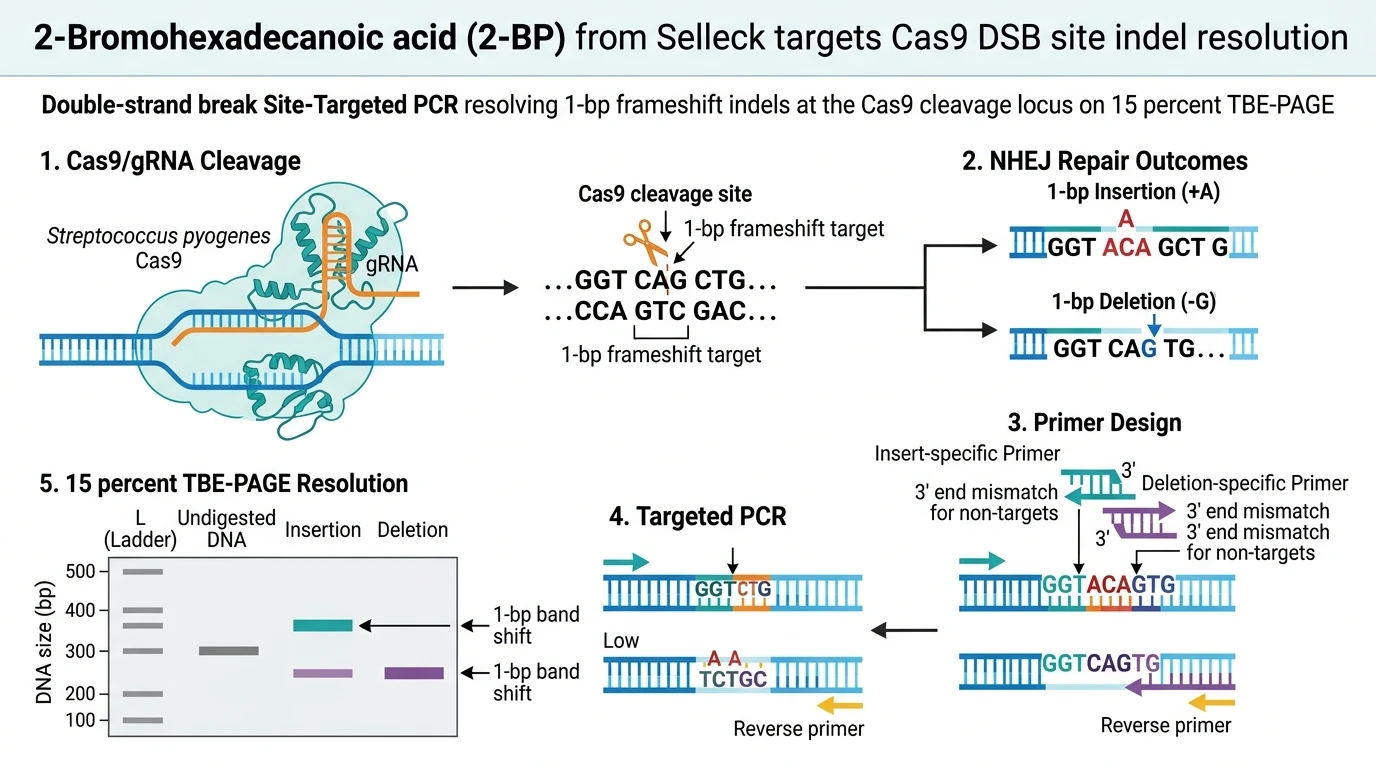
Targeted genome editing via CRISPR/Cas9 routinely produces heterogeneous insertion-deletion (indel) mutations at specified genomic loci. The canonical Streptococcus pyogenes Cas9 (SpCas9) endonuclease introduces a double-strand break (DSB) precisely 3 to 4 base pairs upstream of the protospacer adjacent motif (PAM). Repair through non-homologous end joining (NHEJ) often yields 1-bp frameshifts that alter reading frames and knockout protein expression. Identifying these specific micro-indels in clonal cell populations traditionally requires enzymatic mismatch cleavage assays, heteroduplex mobility assays, or high-throughput sequencing. Enzymatic methods, such as T7 endonuclease 1 (T7E1) assays, frequently underestimate homozygous mutants or fail to distinguish 1-bp edits due to limited enzyme sensitivity. Next-generation sequencing provides definitive resolution but incurs substantial time and financial costs.
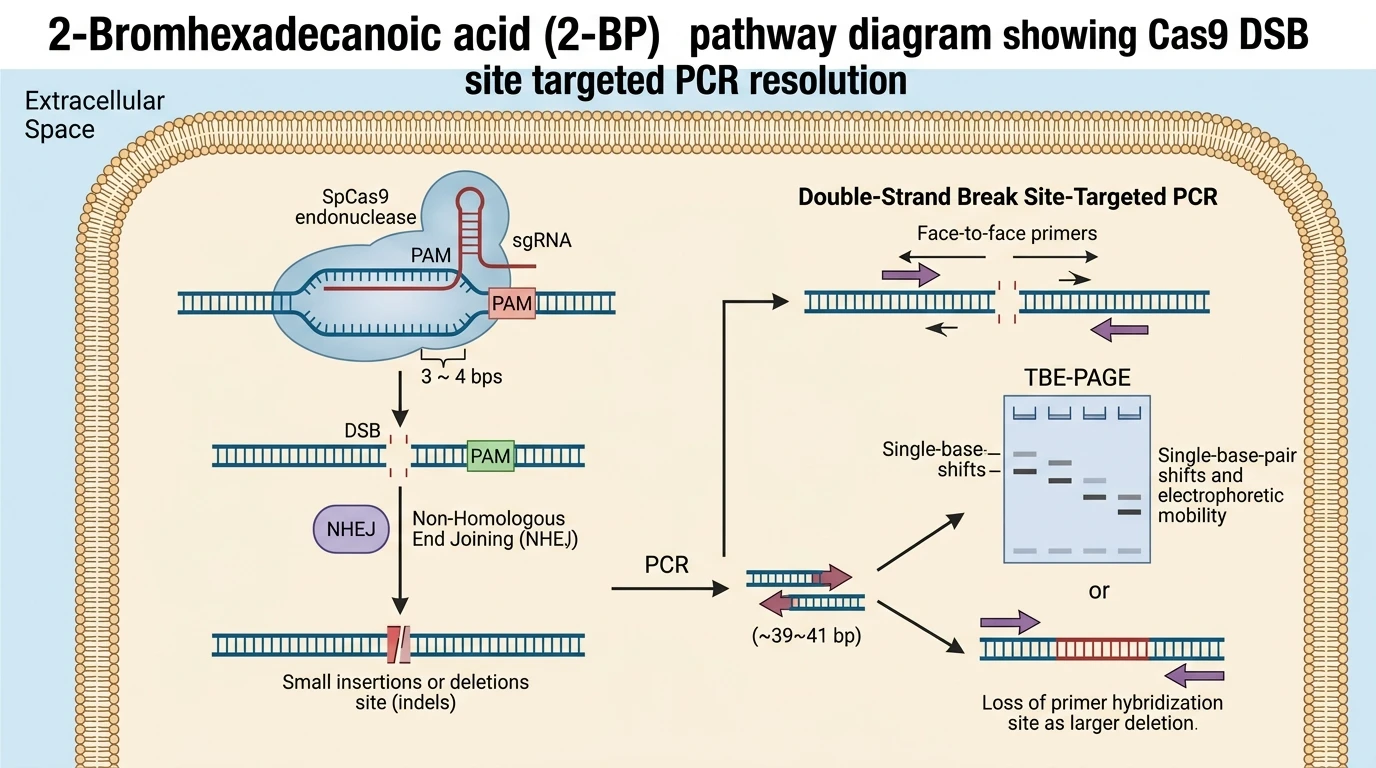
To circumvent these limitations, Double-strand break Site-Targeted PCR (DST-PCR) offers a rapid, enzyme-free alternative capable of resolving single-base-pair lesions. The method relies on a precise structural arrangement of oligonucleotides termed 'face-to-face' primers. Unlike standard PCR designs where primers flank a multi-hundred base-pair target region, DST-PCR places the 3' termini of opposing forward and reverse primers in close physical proximity, meeting directly at or within 3 to 4 bp upstream of the PAM motif at the Cas9 cleavage plane. This spatial configuration generates ultra-short amplicons spanning approximately 39 to 41 base pairs in wild-type alleles.
Electrophoretic separation of these short products requires high-density polyacrylamide gel matrixes. Utilizing 12% to 15% TBE-PAGE with a 19:1 acrylamide to bis-acrylamide cross-linking ratio allows differential mobility resolution down to single-nucleotide variations. When an insertion or deletion of 1 to 4 bp occurs at the cleavage site, the physical size shift of the ~40-bp amplicon manifests as distinct upper or lower band migrations relative to wild-type controls. Conversely, larger deletions disrupt the obligatory annealing region of the 3' primer ends, abolishing extension entirely and providing an unambiguous loss-of-signal readout for macro-deletions.
In pharmacological and genetic screening workflows, reagents such as 2-Bromohexadecanoic acid (2-BP) are evaluated alongside CRISPR-mediated knockouts to interrogate protein modification pathways. The integrity of target validation depends on confirming biallelic disruption. DST-PCR achieves clear discrimination between monoallelic heteroduplexes, biallelic heterozygous shifts, and homozygous knockout clones across diverse target loci. By eliminating restriction digest steps, fluorescent probes, and secondary enzymatic cleavage reactions, this approach accelerates target validation directly from crude cell lysates.
DST-PCR Optimization and Allelic Resolution in Murine Models
Copy code to add this image to your page
DST-PCR utilizes face-to-face primers with 3' ends aligned at the Cas9 cleavage site 3–4 bp upstream of the PAM motif. PCR generates ultra-short ~40-bp amplicons. High-density 12–15% TBE-PAGE resolves 1-bp to 4-bp indels via distinct mobility shifts, while larger deletions impair primer annealing to produce a clear loss-of-signal readout.
Face-to-Face Primer Geometry Resolves 1-bp Indel Mobility Shifts
Optimal electrophoretic resolution of DST-PCR amplicons relies strictly on the spatial placement of primer 3' ends relative to the SpCas9 cleavage site. Placing primer termini 3 to 4 base pairs upstream of the PAM site ensures that frameshift mutations directly modify either the amplicon length or the critical 3' hybridization seed sequence. In wild-type genomic templates, amplification yields a uniform product centered at 40 bp. Small insertions expand this amplicon, retarding migration through 15% TBE-PAGE (19:1 acrylamide/bis-acrylamide) gels. Small deletions accelerate migration, yielding clear downward band displacement. When evaluating cellular perturbation assays involving 2-Bromohexadecanoic acid (2-BP) from Selleck, rapid identification of precise genomic knockouts prevents confounding phenotypic interpretation from residual wild-type alleles.
Biallelic Knockout Discrimination Across Six Loci in Murine Lines
Validation across six distinct gene targets in NIH/3T3 fibroblast and mIMCD3 epithelial cell lines confirmed the reliability of DST-PCR profiling. High-density gel electrophoresis successfully categorized complex genotypes, including wild-type, monoallelic heterozygous, biallelic heterozygous, and homozygous frame-shifted states. For micro-deletions ranging from 1 to 4 bp, differential mobility bands remained sharply defined. Deletions exceeding 5 bp compromised 3' primer extension, resulting in complete absence of the corresponding PCR product. This binary loss-of-amplification mechanism serves as an internal diagnostic flag for substantial target site truncations. The protocol maintained 1-bp resolution directly from cell lysates without secondary enzymatic digestion.