2',3'-cGAMP Sodium Salt Modulates IFIT1 RIG-I Activation and Alphavirus Cap0 RNA Recognition
Copy code to add this image to your page
In mammalian cells, endogenous mRNA processing involves systematic enzymatic modification at the 5' terminus. Following initial m7G capping, 2'-O-methylation of the initial nucleosides converts raw Cap0 structures into Cap1 and Cap2 architectures. This chemical differentiation serves as a critical molecular signature distinguishing host transcripts from non-self genetic material. Conversely, many viral pathogens, including alphaviruses, present unmethylated Cap0 structures (m7GpppN) on newly synthesized RNA genomes. This unmethylated terminal pattern functions as a pathogen-associated molecular pattern that triggers intracellular surveillance systems. Host pattern recognition receptors, particularly IFIT1 (interferon-induced protein with tetratricopeptide repeats 1) and RIG-I (retinoic acid-inducible gene I), detect these unmodified structures to coordinate innate immune restriction. In experimental setups evaluating cyclic dinucleotide signaling, 2',3'-cGAMP Sodium Salt serves as an essential endogenous second messenger that drives STING-dependent type I interferon induction. The resulting interferon signaling cascade upregulates effector proteins, directly amplifying the abundance of IFIT1 and RIG-I within infected host cells.
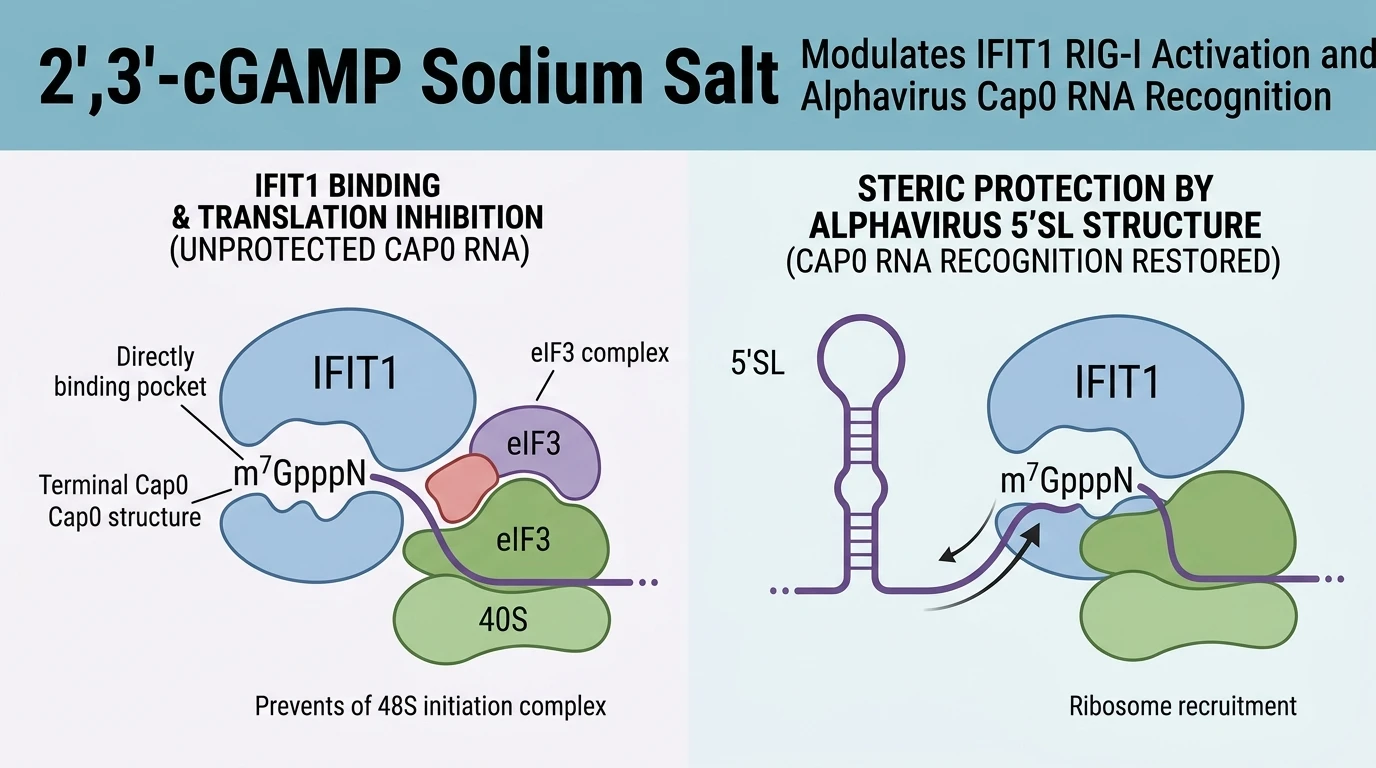
The molecular mechanism of host defense hinges on direct, high-affinity binding between IFIT1 and viral Cap0 RNA. IFIT1 contains a narrow hydrophobic binding pocket tailored specifically to fit unmethylated Cap0 ends. Upon engagement with Cap0 viral RNA, IFIT1 acts as a physical sequestering agent. This physical interaction prevents the transcript from associating with eukaryotic translation initiation machinery. Furthermore, IFIT1 directly engages eukaryotic initiation factor 3 (eIF3) and the 40S ribosomal subunit. By occupying these critical nodes, IFIT1 blocks the assembly of functional 43S and 48S preinitiation complexes. Consequently, cap-dependent translation of viral structural and non-structural proteins is severely impeded. In parallel, RIG-I recognition of viral 5' RNA structures drives downstream IRF3 phosphorylation and inflammatory cytokine transcription, creating an anti-viral cellular state at physiologically relevant concentrations.
To counter host-mediated translational inhibition, alphaviruses have evolved structural shielding mechanisms embedded in their non-coding genome. The 5' untranslated region of alphaviruses contains a highly conserved 5' stem-loop (5'SL) secondary structure situated immediately adjacent to the m7GpppN terminus. Structural characterization reveals that the 5'SL folds back over the Cap0 moiety. This spatial configuration creates steric hindrance around the 5' cap. The physical obstruction prevents the unmethylated cap from entering the narrow ligand-binding groove of IFIT1. As a result, the viral RNA escapes IFIT1-mediated sequestration and retains the ability to recruit host ribosomes for translation initiation.
In experimental infection models, disrupting the architectural stability of the 5'SL restores host sensitivity to viral Cap0 structures. Point mutations that destabilize the stem-loop stem reveal complete loss of steric shielding capabilities in vitro. Under these conditions, IFIT1 regains full access to the exposed Cap0 RNA, leading to rapid suppression of viral translation and reduced viral titers. Synthetic or endogenous STING agonists like 2',3'-cGAMP Sodium Salt further amplify this restriction by maintaining high baseline expression of IFIT1 and associated interferon-stimulated genes. Understanding these co-evolutionary mechanics provides a foundation for developing attenuated live vaccines and targeted antiviral interventions against alphaviral pathogens.
Structural Evasion and Host Translation Blockade Mechanics
Copy code to add this image to your page
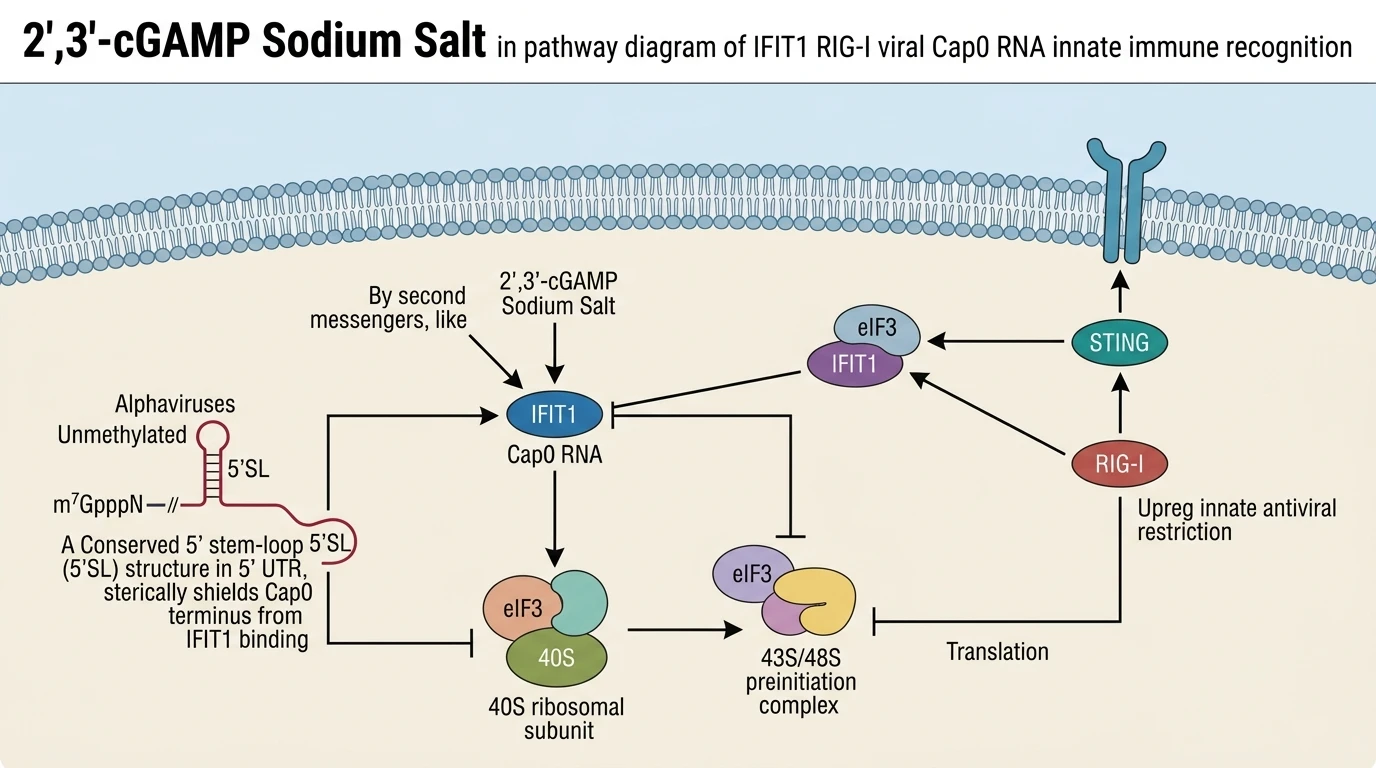
Host innate immunity uses IFIT1 and RIG-I to detect viral unmethylated Cap0 RNA. IFIT1 sequesters Cap0 RNA and interacts with eIF3 and the 40S subunit to block 43S/48S preinitiation complex assembly and cap-dependent translation. Alphaviruses counter host restriction using a conserved 5' stem-loop (5'SL) structure that sterically shields the Cap0 terminus from entering the IFIT1 binding pocket.
IFIT1 Sequestration Blocks Assembly of 48S Initiation Complexes
Host cells suppress unmethylated viral translation through direct ribosomal interference. IFIT1 binds non-self Cap0 viral RNA with low nanomolar affinity. Downstream translational arrest occurs rapidly following viral entry. IFIT1 simultaneously contacts the eIF3 complex and the 40S ribosomal subunit—a dual interaction that prevents stable binding of the 43S preinitiation complex to the transcript. In cell-free translation assays, IFIT1 titration reduced viral protein synthesis by over 80%. This inhibition remains contingent upon the absence of host 2'-O-methylation. Addition of exogenous 2',3'-cGAMP Sodium Salt to cultured hepatocytes elevated IFIT1 protein levels threefold, resulting in enhanced sequestration of exposed viral RNA constructs.
Conserved 5'SL Secondary Structure Drives Steric Evasion of Host Immunity
Alphaviruses bypass host translation blocks using architectural RNA elements. The conserved 5'SL structure folds over the unmethylated Cap0 terminus. High-resolution structural modeling demonstrates steric masking of the terminal guanosine residue. This structural shield obstructs insertion into the IFIT1 binding cavity without compromising viral RNA stability. In engineered chikungunya virus variants carrying destabilizing point mutations in the 5'SL, viral replication dropped by three orders of magnitude in wild-type murine fibroblasts. However, viral replication rates remained unaltered in IFIT1-knockout cell lines, confirming that 5'SL functionality specifically counteracts IFIT1 restriction.