Fasudil (HA-1077) Hydrochloride suppresses HA1077 driven hepatic fibrosis through RhoA/ROCK inhibition
Copy code to add this image to your page
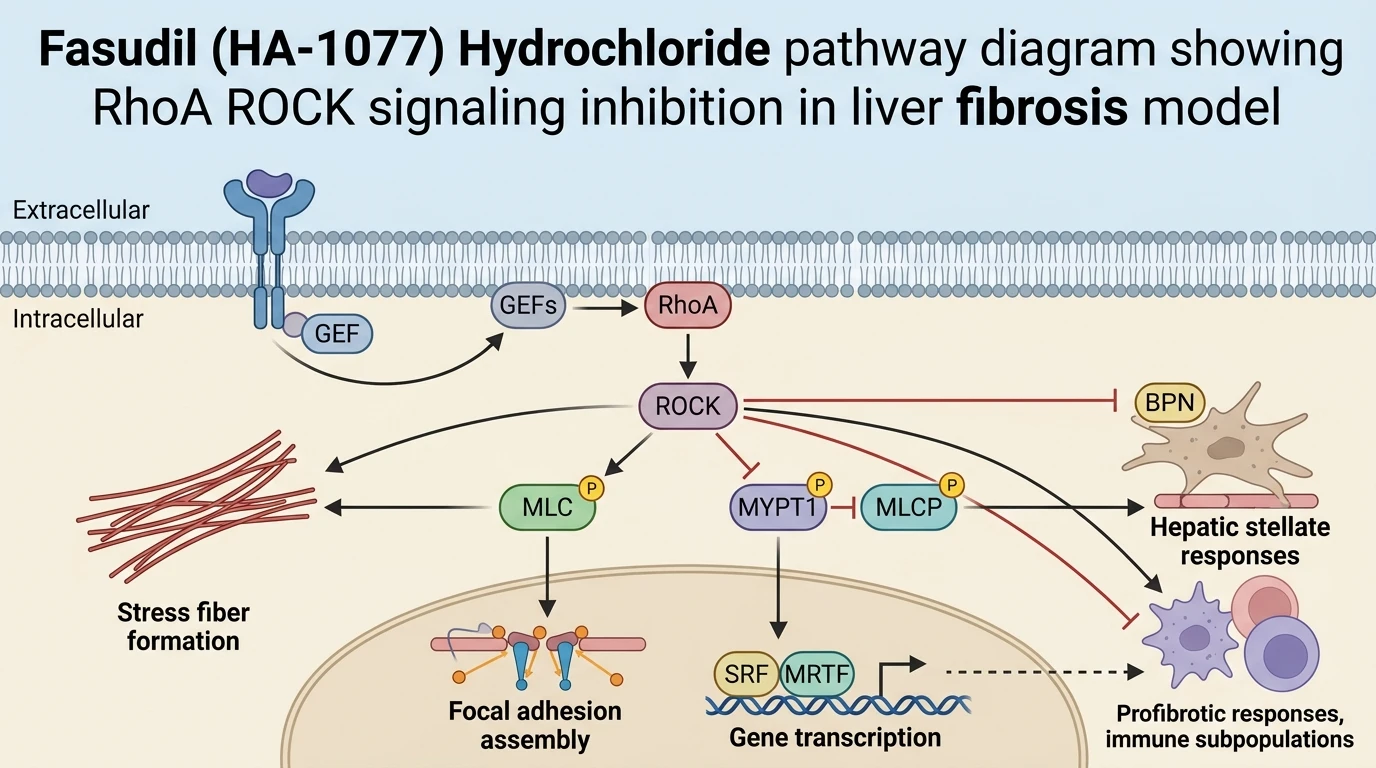
Hepatic fibrosis represents a sustained wound-healing response characterized by excessive extracellular matrix accumulation. Central to this pathobiology is the transdifferentiation of quiescent hepatic stellate cells into activated, contractile myofibroblasts. The RhoA and Rho-associated protein kinase pathway functions as a primary regulator of actin cytoskeletal dynamics, gene expression, and cellular survival during this fibrogenic transition. Fasudil (HA-1077) Hydrochloride, a synthetic isoquinoline sulfonamide derivative, acts as a selective small-molecule inhibitor targeting the ATP-binding catalytic domain of ROCK isoforms. By blocking ROCK phosphorylation of key downstream targets—including myosin light chain and MYPT1—the compound disrupts the mechanical signaling required for stellate cell contractility and persistent activation.
At the molecular level, Fasudil (HA-1077) Hydrochloride occupies the ATP-binding pocket of ROCK, forming specific hydrogen bonds within the hinge region. This competitive binding prevents ATP engagement and subsequent auto-phosphorylation of the kinase domain. Given that ROCK exists as two distinct isoforms, ROCK1 and ROCK2, both of which share substantial homology within their catalytic domains, the compound inhibits both isoforms with nanomolar to low-micromolar potency under standard in vitro assay conditions. Inhibiting this enzymatic activity destabilizes stress fiber formation and focal adhesion assembly, uncoupling the physical stiffness of the fibrotic matrix from intracellular pro-survival signals.
In preclinical models of liver injury, particularly within thioacetamide-induced murine hepatotoxicity studies, systemic administration of HA1077 demonstrates marked therapeutic activity. Pharmacological evaluation reveals that the compound exerts a distinct dual-action mechanism targeting both immune surveillance cells and primary fibrogenic effectors. Within the hepatic microenvironment, native immune populations play a critical role in controlling matrix remodeling. Intrahepatic natural killer cells, in particular, possess the intrinsic capacity to recognize and eliminate activated stellate cells through cytotoxic granule exocytosis and death receptor engagement. However, chronic liver damage typically impairs NK cell functionality, permitting unchecked stellate cell expansion.
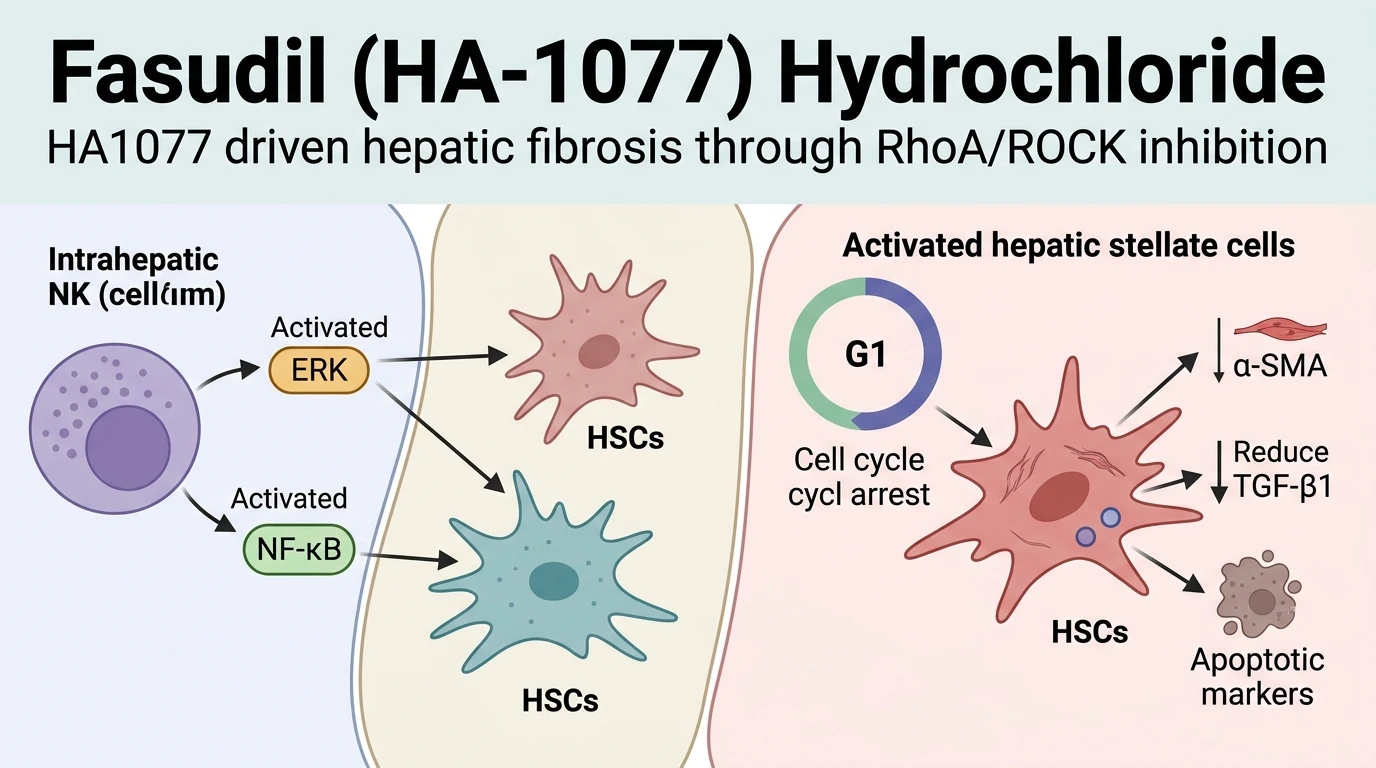
Experimental findings establish that Fasudil (HA-1077) Hydrochloride restores intrahepatic immune surveillance by directly enhancing NK cell responsiveness. Exposure to the compound triggers downstream activation of extracellular signal-regulated kinase and nuclear factor kappa B pathways within intrahepatic NK populations. Increased phosphorylation of ERK1/2 and NF-κB p65 subunits correlates with heightened release of cytotoxic mediators, including perforin and granzyme B. This immune reactivation leads to accelerated clearance of activated hepatic stellate cells in vivo. Notably, this immunomodulatory cascade occurs at concentrations that remain well tolerated within murine treatment regimens, suggesting a favorable therapeutic window for targeting immune-stromal cross-talk.
Concurrently, HA1077 exerts direct cell-intrinsic inhibitory effects on activated hepatic stellate cells. In cultured primary human and rodent stellate cells, treatment leads to a dose-dependent reduction in the transcription and protein expression of alpha-smooth muscle actin, a structural marker of myofibroblastic conversion. Concurrently, expression of transforming growth factor-beta 1—the key driver of fibrotic matrix synthesis—is significantly downregulated. Cell cycle profiling demonstrates that ROCK inhibition induces a pronounced arrest in the G1 phase, suppressing DNA synthesis and mitotic progression. Furthermore, extended exposure to the compound initiates programmed cell death, verified by phosphatidylserine externalization and cleavage of executioner caspases.
In histological analyses of thioacetamide-treated liver sections, therapeutic dosing of the compound reduces Sirius Red-positive collagen areas and hydroxyproline content. Serum alanine aminotransferase and aspartate aminotransferase levels also show significant reductions, reflecting diminished secondary parenchymal injury. Importantly, the observed suppression of hepatic fibrosis occurs alongside a shift in the local cytokine milieu, characterized by diminished pro-inflammatory interleukin concentrations and elevated interferon-gamma production from activated immune cell subsets. These combined data demonstrate that inhibition of the RhoA signaling axis alters both the structural and immunological determinants of chronic liver disease.
Dual Cellular Dynamics in Hepatic Fibrosis Attenuation
Copy code to add this image to your page
Fasudil (HA-1077) Hydrochloride acts as a selective inhibitor of Rho-associated protein kinase (ROCK), interrupting the RhoA downstream cascade. In liver fibrosis, it exerts a dual mechanism: activating intrahepatic natural killer (NK) cells via ERK and NF-κB pathways to boost cytotoxic clearance of activated hepatic stellate cells (HSCs), while directly arresting HSC cell cycle at G1, downregulating α-SMA and TGF-β1, and inducing HSC apoptosis.
NK Cell Cytotoxicity Enhancement via ERK and NF-κB Signaling
In experimental murine models of thioacetamide-induced hepatic injury, the administration of HA1077 shifts intrahepatic immune profiling toward an active cytotoxic state. Natural killer cells demonstrate elevated functional engagement. Phosphorylation of downstream effector nodes—specifically ERK1/2 and the p65 subunit of NF-κB—increases within NK cell populations following exposure to the compound. This signaling cascade amplifies lytic granule release. Consequently, surveillance and clearance of activated hepatic stellate cells improve significantly. In this specific cellular context, the immunomodulatory action operates independently of direct extracellular matrix deposition pathways.
G1 Cell Cycle Arrest in Activated Hepatic Stellate Cells
Beyond immune-mediated mechanisms, direct suppression of myofibroblastic phenotypes occurs upon treatment with HA1077. Activated stellate cells exhibit reduced transcript levels of alpha-smooth muscle actin and transforming growth factor-beta 1 under tested in vitro and in vivo conditions. Cellular proliferation declines markedly. Flow cytometric analysis indicates a clear accumulation of cells in the G1 phase of the cell cycle, preventing progression into S phase. Furthermore, activation of apoptotic machinery leads to a measurable increase in annexin-V positivity. These pharmacodynamic observations highlight a dual-pronged therapeutic strategy wherein direct stellate cell ablation complements immune-mediated clearance within tested preclinical frameworks.